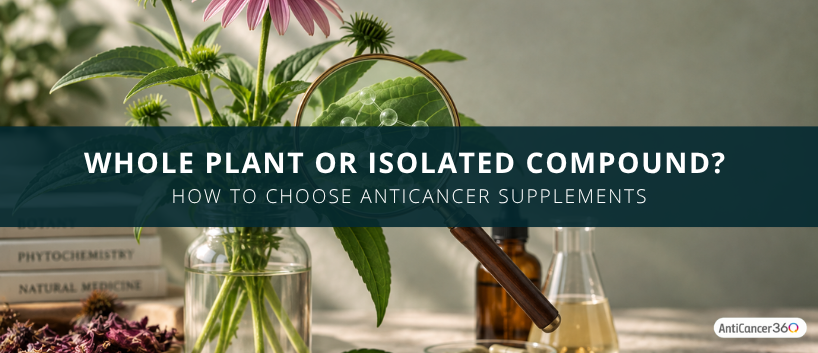
When researching anticancer supplements, you’ll eventually run into the whole plant vs isolated compound debate. One camp says whole foods and whole plants are always better — that nature knows best and isolating a single molecule strips out the magic. The other camp says only standardized, isolated extracts are effective — and that whole herbs are too weak and too inconsistent to matter.
I’ve come to think both camps are half right, and that the argument itself is the mistake. Whole plant versus isolated compound isn’t a contest with one winner. They’re two different tools, for two different jobs. And once you see what each one is actually good at, the question stops being “which is better?” and becomes “which does this particular job need?”
Why We Isolate a Compound: Whole Plant vs Isolated Compound
Let’s dive into the isolated compound side of the debate first, because it has a strong case.
The whole reason to pull one compound out of a plant and concentrate it is dose. For a lot of these substances, you simply cannot eat enough of the plant to reach a level that makes a significant impact.
Curcumin is the classic example. It’s the headline compound in turmeric, and it’s one of the most hyped natural anticancer substances online. But curcumin is notoriously hard to absorb. It’s poorly soluble, and most of what you swallow never makes it into your blood in a meaningful, active form [1]. To get anywhere near the amount used in the studies people cite, you’d have to eat pounds of turmeric a day. That’s not realistic. So we isolate it, concentrate it, and use absorption-enhanced forms to push the level up.
And this connects directly to something I covered in the potency article: a compound is only useful if it can actually reach the tumor at a high enough level, for long enough. If you need real, targeted pressure from a specific mechanism, the isolated and enhanced form is usually the only way to get there. The whole plant, at the amount a person can actually consume, often can’t.
So for a targeted, high-pressure job, isolation isn’t really a compromise. It’s critical.
This is the same way I think about anticancer substances in general, which I laid out in the right tool for the job. This article is the close-up on one specific choice inside that toolbox: when you reach for the concentrated, isolated form, and when you reach for the whole plant or the whole food.
What Isolation Inadvertently Throws Away
Here’s the other half, though. When you pull one molecule out of a plant, you leave the rest of the plant behind — and sometimes the rest of the plant is doing real work.
A whole botanical is already a combination. It’s dozens of compounds acting together, not one purified molecule. It’s nature’s own version of combining many gentle tools at once. Strip it down to a single compound and you can lose two things: other compounds that helped the main one get absorbed or get to work, and other compounds that had useful activity of their own. This is the idea people call the entourage effect, and in some cases it’s very real.
Let me give you three concrete examples, because this is where it gets clear.
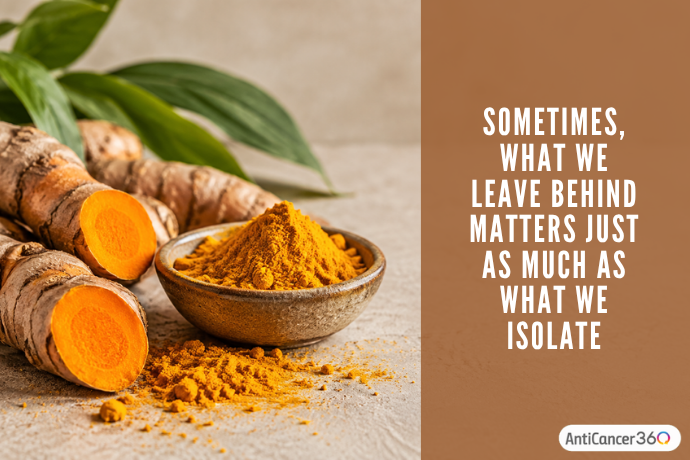
Turmeric versus curcumin. Curcumin absorbs poorly on its own. But turmeric — the whole root — carries other compounds that help. Its natural oils, a group called turmerones, appear to improve how much curcumin your body actually takes up, and they seem to have some activity of their own [2]. Black pepper does something similar: a compound in it called piperine can dramatically raise curcumin absorption, which is why good curcumin formulas include it [3]. So the isolated compound, all by itself, is actually the weak form. The company it keeps is part of why it works.
Broccoli and sulforaphane. Sulforaphane is the well-studied compound from broccoli and broccoli sprouts. But here’s the catch: the plant doesn’t hand you sulforaphane directly. It gives you a precursor plus an enzyme, called myrosinase, and the enzyme has to be present to convert the precursor into the active compound. Many isolated supplements contain the precursor but not the active enzyme, so they underdeliver — while the whole food, or a supplement that preserves the enzyme, does the job [4].
Soursop. This is perhaps the cleanest cancer-specific example I know of. In a 2015 study, researchers compared the whole graviola extract against its isolated, most-active fraction. The isolated fraction was the strongest at killing the cancer — but it was also highly toxic to the animals. The whole extract, with everything in its natural balance, fought the cancer effectively and did not kill the animals [5]. There, isolation didn’t just lose some synergy. It stripped away the plant’s own safety and left something more dangerous.
Holding This to an Honest Standard
Now I have to turn the same skepticism on the whole-plant side, because “natural, therefore better” is its own trap — and the supplement industry sells it hard.
The entourage effect is real in specific, studied cases. But it is also routinely oversold. For every clean example like turmerones or sulforaphane, there are dozens of “full spectrum” products where the synergy is a marketing claim, not a measured effect. And a lot of the supporting evidence is preclinical — cells and animals — which means my usual caution applies: only about one in ten things that work in the lab or in animals end up holding up in people [6].
Whole-plant products carry a second problem: consistency. The amount of active compound in a raw botanical can swing enormously from batch to batch. With the raw soursop fruit, for instance, the acetogenin content has been measured varying more than tenfold between different samples [7]. So “whole plant” can also mean “unpredictable dose,” which is exactly what you don’t want when you’re trying to do something deliberate.
And here’s the example that really drives it home: sometimes the whole plant is the dangerous form. Take butterbur, a plant used for migraines and allergies. Its benefit comes from specific compounds called petasins.
But the raw plant also carries a group of compounds called pyrrolizidine alkaloids — and those are toxic to the liver, and potentially carcinogenic. So here, the whole plant is the risky version, and the isolated form is the safe one: a standardized extract with the toxic alkaloids stripped out, keeping the petasins that actually help. That’s the exact mirror image of the soursop lesson. With soursop, isolating the compound made it more toxic.
With butterbur, isolating it is what makes it usable at all. And even then it’s not a free pass — some purified butterbur products have still shown mild liver-enzyme changes, and testing has caught “PA-free” supplements that weren’t, which is part of why a major neurology group pulled back its recommendation over manufacturing concerns [8]. “Natural” and “whole” don’t mean “safe.” “Isolated” doesn’t mean “stripped of value.” You have to know the specific plant.
So I hold both sides to the same bar. Isolated isn’t automatically more “real.” Whole isn’t automatically more “complete.”
So Here’s How I Actually Split It
Put all of that together and you get a practical rule— and this is what I actually do.
For the handful of targeted compounds where I want real pressure on a specific mechanism, I use the isolated, standardized, absorption-enhanced form. This is the high-pressure job. You need a reliable dose and you need it to actually get absorbed, and the concentrated form is the only way to get there. Trying to do this with a raw herb means an unknown, probably too-low dose.
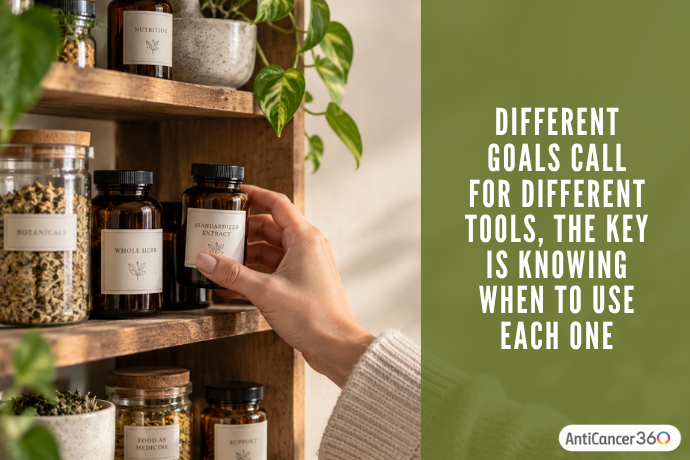
For everything else — the broad, gentle base — I lean on whole foods and whole herbs. This is the many-angles job. You’re not trying to hammer one target; you’re trying to give the body a wide, steady spread of supportive compounds, in their natural balance, the way food delivers them. You can’t and shouldn’t try to get that from a shelf of capsules.
There’s also a practical reason to reach for the whole form: sometimes it’s the only form there is. A lot of the compounds I find most interesting in Chinese herbal medicine have real, emerging anticancer research behind them. But you simply can’t buy them as isolated, standardized supplements. Nobody makes them that way.
So in those cases, using the whole herb isn’t a philosophical choice about the entourage effect. It’s just the only way to get the compound into the body at all. When that’s the situation, we use the whole herb — carefully, alongside conventional care, and with the same eye on quality and consistency I mentioned earlier.
And there’s one more important nuance: “isolated” doesn’t always mean a single molecule. Sometimes the right tool is a standardized whole-plant extract — concentrated enough to give you a real, consistent dose, but still carrying the plant’s fuller mix rather than one purified compound.
Soursop is exactly this case: the lesson from that 2015 study isn’t “take purified acetogenins,” it’s “a standardized whole extract beats the isolated fraction.” So it’s not so much a whole-versus-isolated debate. It’s how concentrated and how targeted does this particular job need to be.
Also, none of this replaces conventional treatment. As with everything we talk about, these are experimental, supportive approaches, used alongside conventional care, and they make the most sense in the harder, more advanced cases. How aggressive to get at all is its own decision, and I’ve mapped that out separately.
It’s All About Balance
I also think about this debate from my Eastern-medicine training and perspective. We think of everything in yin vs. yang (i.e. cold vs hot, wet vs dry, female energy vs male energy.) And everything in life tends to require a balance of these opposites.
Concentrating and isolating a compound is the aggressive, focused aspect — the yang. Eating the whole plant, whole food, or whole herb in its natural balance is the nutritive, sustaining aspect — the yin. It’s broad and gentle.
Health lives in the balance between them. When you’re fighting cancer, you deliberately tip toward the concentrated tools for a season, because the situation calls for it. But you don’t abandon the base. The isolated compound and the whole food aren’t rivals. They’re the two halves of the same approach — and knowing which one a given job needs is most of the skill.
The Bottom Line
Whole plant or isolated compound is the wrong question, because it assumes one has to win. Isolating a compound is how you get a specific mechanism up to a dose that actually does something — and for the targeted, high-pressure jobs, that’s exactly what you want. But isolation also strips away the other compounds that were helping, and sometimes even the plant’s own safety, which is what the whole-food form preserves.
So I use both, on purpose: the concentrated, absorption-enhanced form for the few targeted compounds that need real pressure, and whole foods and whole herbs for the broad, gentle base underneath. Match the form to the job — not to a headline about which one is “natural” or which one is “strong.”
[Embedded video / related links here]
Frequently Asked Questions
Is a whole-plant supplement better than an isolated extract? Neither is better across the board — they do different jobs. Isolated, concentrated forms let you reach a real, targeted dose of one compound, which the whole plant often can’t deliver. Whole plants and whole foods carry a fuller mix of compounds that can help each other work (the “entourage effect”). The useful question is which the specific job needs, not which is better in the abstract.
Why is turmeric sometimes better than curcumin? Curcumin, the isolated compound, is poorly absorbed on its own. Whole turmeric carries other compounds — its natural oils (turmerones), for example — that appear to improve curcumin’s absorption and add some activity of their own, and black pepper’s piperine does the same. So the isolated compound by itself is actually the weaker form unless it’s paired with absorption helpers.
What is the entourage effect? It’s the idea that the many compounds in a whole plant can work together — one improving another’s absorption or adding its own effect — so the whole is more than the isolated part. It’s real in specific, studied cases (turmeric, broccoli), but it’s also frequently oversold as a blanket marketing claim, and much of the evidence is still preclinical.
Should I just eat the whole food instead of taking supplements? Often, for the broad base, yes — whole foods are how I’d cover the wide, gentle spread of supportive compounds. But for a few targeted compounds where you need a real therapeutic dose, you usually can’t eat enough of the food to get there, so an isolated, absorption-enhanced form makes more sense. Most sensible plans use both.
Are whole-plant supplements less reliable? They can be. The amount of active compound in a raw botanical can vary widely from batch to batch — raw soursop fruit, for instance, has been measured varying more than tenfold. That’s why, when a consistent dose matters, a standardized extract is often the better choice than a raw whole-plant product. Always coordinate any supplement with your medical team, especially during treatment.
Disclaimer
⚖️ This content is for educational purposes only and reflects clinical observations and emerging research. It is not medical advice and is not intended to diagnose, treat, cure, or prevent any disease. The methods discussed are experimental and are generally most appropriate for advanced cases where conventional treatments have limited proven benefit. They should be considered alongside, not instead of, conventional medical care, and only under the supervision of qualified medical professionals familiar with your specific case. Individual results vary. Anticancer360 does not replace your oncologist or primary care team. Always consult your treating physicians before making changes to your treatment plan, diet, or supplement regimen.
Which describes you best?
Please select one of the options below, and you'll be guided to the online training that best fits your situation.

I'm fighting an advanced (or late stage) cancer and I'm determined to "beat the odds."

I'm fighting an earlier staged cancer, and want to maximize the outcome & minimize the side effects.
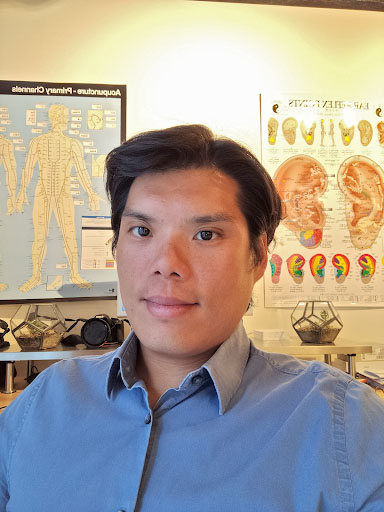
Gene Wei is a Board Certified Doctor of Oriental Medicine in the state of Florida, and the founder of AntiCancer360. He’s also a graduate of the University of California Los Angeles, and East West College of Natural Medicine.
His practice focuses on aggressive integrative strategies used alongside conventional oncology care, particularly for advanced and difficult cancers.