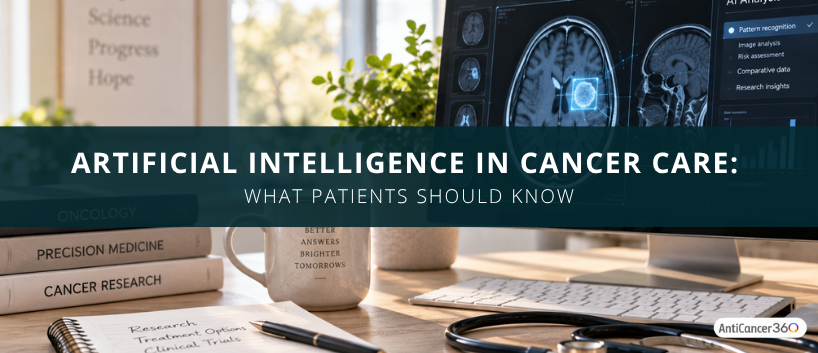
Today, AI can help clinicians detect cancer, analyze medical images and pathology slides, organize complex medical information, and identify potential clinical trials. But AI is not replacing oncologists, radiologists, pathologists, or the human relationships at the center of cancer care.
Understanding what AI can do — and what it cannot — can help you separate its genuine potential from the hype.
Key Takeaways
- AI is already being used in healthcare, particularly in areas such as medical imaging, pathology, and clinical decision support.
- AI is very good at identifying patterns in enormous amounts of data, but it does not understand a person or their cancer the way a healthcare professional does.
- Randomized clinical trial evidence now suggests that AI-assisted mammography can improve some measures of breast cancer screening while reducing radiologist workload.
- AI may also help organize increasingly complex cancer information and identify potential clinical trial matches, although many of these applications are still being studied and refined.
- The future of AI in cancer care is likely to involve technology supporting healthcare professionals rather than replacing the human relationships that make good cancer care possible.
At AntiCancer360, our work brings us alongside people navigating cancer while continually reviewing the evolving research around treatment, supportive care, and whole-person health. That gives us a particular interest in AI: not simply what the technology can do, but whether it can help us provide more informed, thoughtful, and personalized support.
AI Is Powerful Because It Can Find Patterns Humans May Miss
Artificial intelligence refers broadly to computer systems that can perform tasks that normally require aspects of human intelligence, such as recognizing patterns, processing language, or making predictions from large amounts of information.
AI does not think or feel the way humans do. It does not possess consciousness, intuition, or wisdom.
What it does remarkably well is process information.
Imagine asking one person to review hundreds of thousands of mammograms and remember every subtle pattern they have ever encountered. A human brain simply cannot process information at that scale. An AI system can compare enormous numbers of data points very quickly and identify statistical patterns that might be difficult for the human eye to recognize.
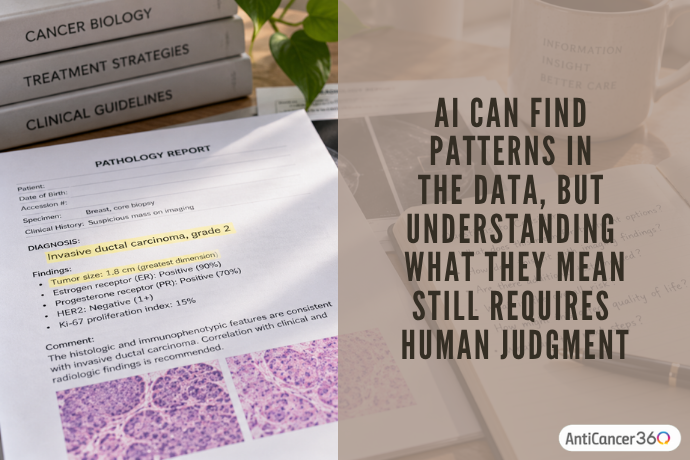
This ability has made AI particularly interesting in oncology, where a single person’s cancer may generate information from imaging, pathology, laboratory testing, genomic sequencing, biomarkers, treatment history, symptoms, and an ever-growing body of medical research.
AI offers a new way to help make sense of some of that complexity.
But there is an important catch.
AI Recognizes Patterns, but It Does Not Understand Your Cancer
One simple way to think about artificial intelligence is learning through repetition and pattern recognition.
Imagine showing someone thousands of pictures of dogs and cats. Over time, patterns become recognizable: ear shape, facial structure, fur, body proportions. Eventually, a new picture can be classified based on similarities to everything seen before.
Machine learning operates on a much larger and more mathematical scale.
An AI system might be trained using thousands or millions of medical images, pathology slides, genetic markers, medical records, or treatment outcomes. It learns relationships within that information and then uses those relationships to make predictions about new information.
That distinction matters.
AI is not looking at a pathology slide and understanding what it means to have cancer. It is calculating patterns based on the information and examples it has been given.
The quality of those predictions therefore depends heavily on the quality and representativeness of the data used to build and test the system. A model that performs extremely well in one population, hospital, or dataset may not automatically perform equally well everywhere.
That is one reason human oversight remains so important.
AI Is Already Helping Doctors Detect Cancer
One of the strongest areas of evidence for AI in cancer care is medical imaging.
Radiologists examine mammograms, CT scans, MRIs, and other images looking for abnormalities that may represent cancer. AI systems can be trained to highlight suspicious areas or estimate the likelihood that an image contains a malignancy.
And this is no longer limited to laboratory experiments.
The MASAI study, a randomized controlled breast cancer screening trial conducted in Sweden, compared AI-supported mammography screening with standard screening involving two radiologists. Follow-up results published in The Lancetin 2026 found that AI-supported screening achieved favorable screening performance, including a lower rate of cancers diagnosed between scheduled screenings. This is randomized human evidence — a considerably stronger level of evidence than a computer simulation or retrospective study [1].
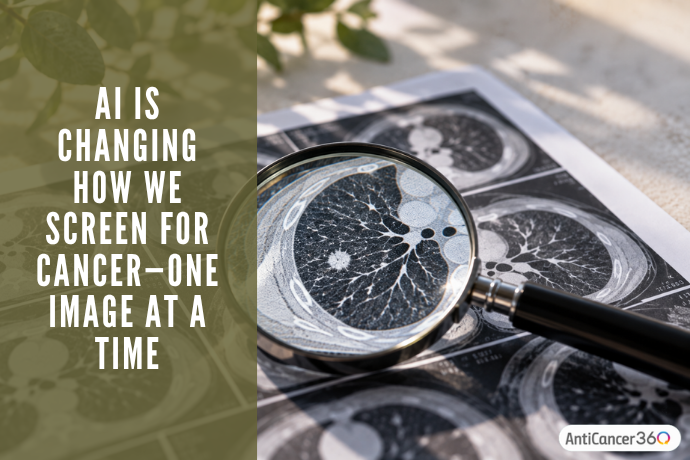
The study does not mean AI should independently read every mammogram or that the same results automatically apply to every healthcare system. It does, however, provide meaningful evidence that carefully tested AI can support clinicians in real-world cancer screening.
The U.S. Food and Drug Administration has also authorized numerous AI-enabled medical devices, with radiology representing a major area of development [2].
Think of these tools less as replacing the radiologist and more as adding another highly specialized set of eyes.
AI Can Find Information Hidden Inside Tumor Samples
Medical imaging is only part of the story.
Pathologists examine tissue removed during a biopsy or surgery to determine whether cancer is present and to understand characteristics of the tumor. Increasingly, researchers are developing AI systems capable of analyzing digitized pathology slides.
A 2024 study published in Nature Medicine, for example, evaluated a large AI foundation model for computational pathology across common and rare cancers. The model demonstrated strong cancer-detection performance and was also evaluated for tasks such as biomarker prediction [3].
This is promising research, but the distinction in evidence matters: studies validating an AI model’s ability to recognize cancer are not the same as randomized trials showing that using the model improves patient outcomes.
For now, the more realistic vision is AI-assisted pathology.
An AI system might identify a subtle pattern, quantify something that would be extremely time-consuming to measure manually, or flag an area deserving closer attention. A pathologist then places that information within the much larger clinical picture.
The computer finds patterns.
The clinician decides what those patterns mean for the person sitting in front of them.
AI May Help Make Cancer Treatment More Personalized
Cancer treatment has changed dramatically over the past several decades.
Two people may both be diagnosed with breast cancer, lung cancer, or colorectal cancer while having tumors that behave very differently. Genetic mutations, biomarkers, molecular characteristics, stage, previous treatments, overall health, and personal preferences can all influence treatment decisions.
This movement toward precision medicine is exciting, but it creates an extraordinary amount of information for healthcare teams to process.
A clinician may need to consider imaging findings, pathology reports, genomic testing, biomarker results, prior treatment responses, current medications, medical history, and rapidly changing research literature at the same time.
AI may eventually help organize and analyze these layers of information more efficiently.

Some AI-based clinical decision-support systems are being studied for their ability to identify relevant treatment options, summarize medical information, or detect patterns across large datasets. However, much of this work remains investigational, and an AI-generated treatment suggestion is not equivalent to a treatment recommendation from an oncology team.
That distinction is important.
Cancer treatment is not simply a data-matching exercise. The “best” treatment on paper may not be the best treatment for a particular human being.
AI Could Help More Patients Find Relevant Clinical Trials
Clinical trials are essential to advancing cancer treatment, yet finding an appropriate trial can be surprisingly difficult.
Eligibility criteria may involve cancer type, stage, mutations, previous treatments, laboratory values, medical history, medications, and dozens of other details. Matching all of those criteria against available trials can require substantial manual review.
This is an area where AI may be particularly useful.
A 2026 study in JCO Clinical Cancer Informatics evaluated an AI-driven system that used information from electronic health records to help prescreen people for cancer clinical trials. After initial validation, researchers implemented the system across 29 trials spanning multiple cancer specialties and phases [4].
Other recent studies have also reported promising results using AI to identify potential trial matches.
These systems are not a replacement for the clinical research teams who ultimately determine eligibility. But they may eventually help narrow thousands of possibilities into a smaller group worth investigating.
For someone with cancer, that could mean fewer potentially relevant opportunities slipping through the cracks.
The More Powerful AI Becomes, the More Human Judgment Matters
There is an understandable fear that AI will eventually replace physicians.
Cancer care illustrates why the reality is more complicated.
AI may become extraordinarily good at identifying patterns. It may help a radiologist see something subtle, help a pathologist analyze a slide, or help an oncologist sort through an overwhelming amount of information.
But information is only one part of medicine.
Cancer exists in real lives, real families, and real stories.
AI cannot sit beside someone moments after hearing the words, “You have cancer.”
It cannot notice tears beginning to form before they fall. It cannot sense the heaviness in a room or understand the silence that sometimes carries more meaning than words.
Some of the most healing moments in medicine are difficult to measure.
They happen when someone feels truly seen. They happen when a provider sits down rather than standing at the doorway. They happen when fear is spoken aloud for the first time and another person remains present enough to hear it.
AI also cannot independently decide what matters most to you.
One person may want to pursue every available treatment option. Another may prioritize quality of life, remaining at home, attending a daughter’s wedding, minimizing a particular side effect, or simply having more good days with family.

Those decisions require more than prediction.
They require relationship, communication, values, judgment, and trust.
Cancer treatment is deeply human.
At AntiCancer360, AI Is a Tool for Supporting Human Care
At AntiCancer360, we are also beginning to use AI in ways that may help us work more efficiently and continue evolving our approach to care.
AI can help streamline repetitive or time-consuming tasks, giving us more space for what matters most: supporting our clients and strengthening human connection.
It can also help us organize emerging research and explore relationships between research-based theories and what we observe through real-world experience. With an enormous amount of new health and cancer research published each year, tools that help us identify and organize relevant information can be valuable.
But AI does not get the final word.
Research still needs to be evaluated critically. Medical information needs context. And every person’s situation deserves to be considered individually.
Our goal is not to replace human insight with artificial intelligence. It is to use thoughtful tools to help us build more informed, personalized, and human-centered approaches to care.
The Future of Cancer Care May Be Human Intelligence Supported by AI
The future of cancer care may not be artificial intelligence versus human intelligence.
It may be artificial intelligence supporting human intelligence.
AI could help identify cancers earlier, reveal patterns hidden within complex medical information, improve clinical trial matching, and reduce some of the administrative burden placed on healthcare professionals.
Used well, that could create something surprisingly human: more time.
More time for a radiologist to focus on an ambiguous scan. More time for an oncologist to talk through treatment choices. More time for a nurse to answer the question a patient was afraid to ask.
Technology may continue to transform medicine.
But healing has always involved more than data.
At the center of cancer care will remain something no algorithm can fully replicate:
Human connection.
Frequently Asked Questions About AI and Cancer Care
Can AI diagnose cancer by itself?
AI can help identify patterns associated with cancer in medical images, pathology slides, and other clinical information, but it should not be viewed as a replacement for a qualified healthcare professional. Even when an AI tool performs well in clinical studies, its findings must be interpreted within the larger medical picture.
Is AI already being used in hospitals?
Yes. AI-enabled medical devices are already authorized for use in the United States, particularly in radiology and medical imaging. However, “AI” covers many different technologies, and their roles vary considerably. Some assist with image interpretation or workflow, while others remain primarily research tools.
Will AI replace oncologists or radiologists?
Current evidence supports AI primarily as a tool that can assist healthcare professionals. AI can process information and identify patterns quickly, but cancer care also requires clinical judgment, communication, ethical decision-making, and an understanding of each person’s goals and circumstances. Those responsibilities remain fundamentally human.
Can AI tell me which cancer treatment is best for me?
AI may help clinicians organize complex information or identify potential treatment options, but it cannot independently determine the best treatment for an individual. Treatment decisions should be made with your oncology team based on your cancer biology, medical history, available evidence, personal preferences, and treatment goals.
Can AI help me find a clinical trial?
Potentially. AI-based systems are being studied and implemented to help prescreen medical records against complex clinical trial eligibility criteria. Recent human studies suggest these tools can make the matching process more efficient, but final eligibility still requires review by the clinical trial team.
Is AI in cancer care always accurate?
No. AI systems can make mistakes, and their performance depends on factors such as the data used to train them, the population in which they are used, and the specific clinical task. This is why validation, regulatory oversight, ongoing monitoring, and human review remain essential.
One next step: If you encounter an AI-generated recommendation or AI-assisted result during your cancer care, ask your healthcare team how that information was generated and how it fits into your individual treatment plan.
This article is for educational purposes and is not a substitute for individualized medical advice. Cancer screening and treatment decisions should be made with your qualified healthcare team.
Which describes you best?
Please select one of the options below, and you'll be guided to the online training that best fits your situation.

I'm fighting an advanced (or late stage) cancer and I'm determined to "beat the odds."

I'm fighting an earlier staged cancer, and want to maximize the outcome & minimize the side effects.

Samantha is a registered nurse, and Integrative Health Coach with Anticancer360. She holds a Bachelor of Science in Nursing from the University of Tulsa, and brings a unique blend of clinical expertise and whole-person care to support our clients along their healing journeys. She has spent the past 15 years as a registered nurse and clinical case manager at UCLA, where her work has been deeply rooted in oncology care.