The gut microbiome and cancer have become an important focus of research, as scientists explore how the trillions of microorganisms living in your gut may influence cancer treatment.
Together, these bacteria, viruses, fungi, and other microbes form your gut microbiome—a complex ecosystem involved in digestion, metabolism, immune function, and the health of the intestinal lining. Cancer researchers are increasingly studying whether this ecosystem may also influence how people experience and respond to certain cancer treatments.
But supporting your microbiome does not require chasing the perfect probiotic or trying to cultivate a specific “good” bacterium. For most people, the more useful place to start is with the environment those microbes live in: what you eat, the medications you need, your current treatment, and what your digestive system can realistically tolerate.
Key Takeaways
- Think ecosystem, not individual bacteria. A healthy gut microbiome is a diverse community, and researchers are still learning what an “ideal” microbiome looks like from one person to another.
- Food may be one of the most practical ways to support the microbiome. Fiber-rich plant foods provide substrates that gut microbes can use, while dietary variety exposes the microbiome to different types of fibers and plant compounds.
- Fermented foods may support microbial diversity, but cancer treatment changes the equation. Food safety, immune status, and GI symptoms matter, so fermented foods are not appropriate for everyone at every point in treatment.
- Probiotic supplements are not automatically better for your gut. Their effects are strain-specific and individual, and some cancer centers recommend against taking over-the-counter probiotics during treatment without discussing them with your care team.
- Antibiotics can disrupt the microbiome, but sometimes they are lifesaving. The goal is appropriate antibiotic use—not avoiding a medication you genuinely need.
As an oncology RN and integrative health coach, I have watched nutrition advice become increasingly complicated for people with cancer. The microbiome is a perfect example: the science is fascinating, but the goal should be to translate that science into choices that support your health without creating another set of rules you feel pressured to follow.
Your Gut Microbiome Is More Like a Rainforest Than a Supplement Bottle
It is tempting to divide gut bacteria into “good” and “bad.” In reality, the microbiome behaves much more like an ecosystem. As research into the gut microbiome and cancer continues, the most practical approach is to support gut health in ways that fit your individual needs and current treatment.
Imagine a rainforest. Its health does not depend on having one particular tree. It comes from the relationships among thousands of organisms sharing resources, competing, adapting, and helping maintain the larger environment. Your gut microbiome works in a similarly complex way.
That is one reason microbial diversity gets so much attention. Researchers have associated changes in the composition and diversity of the microbiome with numerous aspects of health, and cancer researchers are investigating how gut microbes interact with immunity and treatment response. But scientists have not identified one universal microbiome that everyone should be trying to create. Even among healthy people, microbial communities vary considerably.
This distinction matters because much of the marketing around gut health implies that you can “fix” your microbiome by adding a handful of supposedly beneficial bacteria.
The science is not nearly that simple.
A better goal is to support the ecosystem as a whole—while recognizing that cancer treatment may temporarily change what that support needs to look like.
Feed the Ecosystem With a Variety of Plant Foods
If there is one microbiome strategy worth focusing on first, it is probably food.
Dietary fiber passes through much of the digestive tract without being fully broken down by human digestive enzymes. Once it reaches the colon, certain gut microbes can ferment it, producing compounds called short-chain fatty acids, including butyrate. These compounds have roles in intestinal barrier function and communication between the microbiome and the body.
Fiber also does not come in just one form. Oats, lentils, berries, apples, onions, nuts, seeds, whole grains, beans, and leafy vegetables contain different fibers and plant compounds. Eating a variety of plant foods therefore provides different substrates for different members of the microbial community.
For general cancer prevention, the World Cancer Research Fund recommends making whole grains, vegetables, fruit, and legumes a major part of the diet and aiming for about 30 grams of fiber per day from food. For someone actively receiving cancer treatment, however, that number should be considered a general population target—not a mandate.
If you currently eat very little fiber, increasing it gradually may be easier on your digestive system. Rather than suddenly doubling your intake, you might add berries or ground flaxseed to breakfast, replace a refined grain with a whole grain, or add a small serving of beans or lentils to a meal.
And variety matters more than turning this into another number to track.
You could simply ask yourself: Can I add one plant food I haven’t eaten yet this week? Over time, rotating among vegetables, fruits, beans, lentils, whole grains, nuts, seeds, herbs, and spices can create considerably more variety than eating the same salad every day.
During Cancer Treatment, More Fiber Is Not Always Better
This is where general gut-health advice can fail people with cancer.
Chemotherapy, radiation involving the digestive tract, surgery, medications, infections, and the cancer itself can all affect appetite and GI function. Diarrhea, constipation, nausea, abdominal discomfort, early fullness, and difficulty maintaining weight may temporarily change what your body tolerates. Nutrition during cancer treatment also needs to protect adequate calories, protein, hydration, and overall nutritional status.
Someone with significant diarrhea, bowel narrowing, a recent GI surgery, or another digestive complication may be told to temporarily reduce certain high-fiber foods. Someone struggling to maintain weight may need to prioritize foods they can actually eat rather than trying to meet an arbitrary plant-diversity goal.
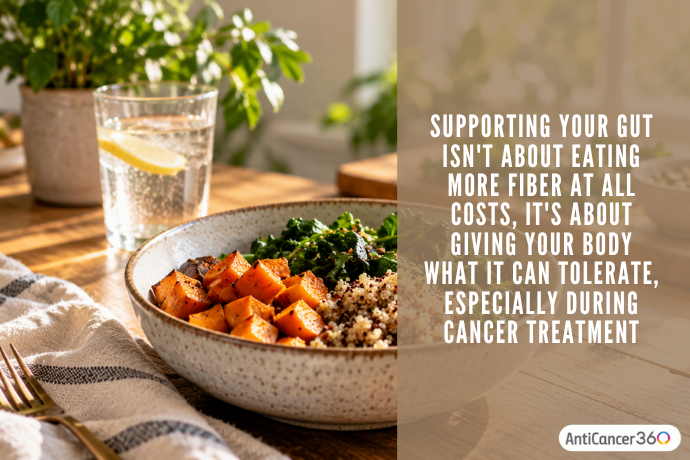
In other words, supporting your gut does not mean forcing your gut to tolerate foods it currently cannot handle.
If treatment has significantly changed your digestion, ask your oncology team or oncology dietitian what makes sense right now. Sometimes supporting recovery means gradually building dietary variety. At other times, the most supportive choice is temporarily simplifying your diet and expanding it again when your body is ready.
Fermented Foods Can Add Something Fiber Cannot
Fiber feeds microbes already living in your gut. Fermented foods approach the ecosystem from a different direction.
Foods such as yogurt with live cultures, kefir, kimchi, sauerkraut, miso, and tempeh are created through fermentation and may contain live microorganisms or compounds produced during fermentation.
One interesting randomized study published in Cell assigned healthy adults—not people with cancer—to diets high in either fiber or fermented foods. Over the intervention, the fermented-food group experienced an increase in microbiome diversity along with decreases in several inflammatory markers. The high-fiber diet changed microbial function but did not increase microbial diversity across the group, and individual responses varied based partly on participants’ starting microbiomes [1].
That last part is especially interesting: the same food intervention did not produce the same response in everyone.
It is another reminder that microbiome health is unlikely to come from a universal formula.
If fermented foods are already safe for you, you do not need six servings a day to begin experimenting with them. A serving of pasteurized yogurt with live cultures, a little cooked miso, or another fermented food that fits your diet may be a reasonable place to start.
Cancer treatment adds an important caveat, though. People with weakened immune systems may need stricter food-safety precautions, and some fermented products—particularly unpasteurized or home-fermented products—may carry additional microbial risk. Cancer centers may also restrict foods such as kefir, kombucha, or uncooked fermented products in certain immunocompromised patients.
If you are neutropenic, have recently had a stem-cell transplant, or have been given specific food-safety instructions, follow those recommendations rather than general microbiome advice.
A Probiotic Supplement Is Not the Same Thing as a Healthy Microbiome
This may be the most counterintuitive part of the conversation.
If beneficial bacteria are important, it seems logical that swallowing more beneficial bacteria should improve the microbiome. But probiotics do not work like replacing a vitamin you are deficient in.
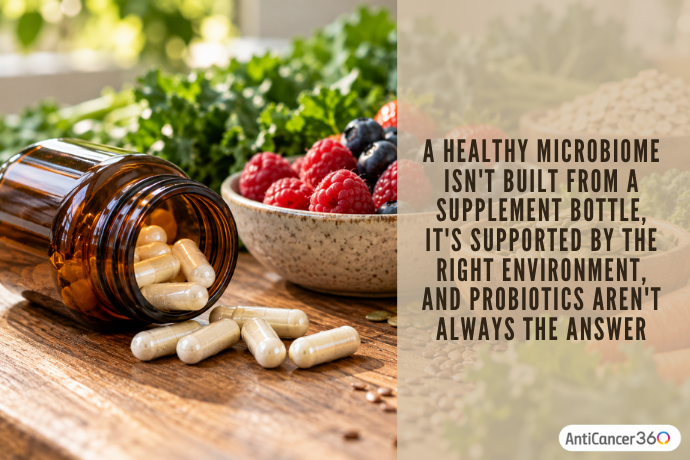
Different probiotic products contain different species and strains, at different doses, and those organisms do not necessarily become permanent members of your microbiome. Research also suggests that people can respond differently to the same probiotic, and in some studies probiotics taken after antibiotics have actually delayed the return of a person’s original microbiome.
The cancer-specific evidence deserves even more caution.
A frequently cited 2021 study followed people with melanoma receiving immune checkpoint inhibitors. Higher dietary fiber intake was associated with better progression-free survival, particularly among participants who did not report using over-the-counter probiotic supplements. However, this was not a randomized trial proving that fiber improves immunotherapy or that probiotics worsen cancer outcomes, and the finding should not be generalized to every cancer or treatment [2].
That uncertainty is exactly why some major cancer centers recommend that patients not start an over-the-counter probiotic on their own during treatment. Probiotic supplements may also pose infection risks for people who are significantly immunocompromised or have a central venous catheter.
This does not mean probiotics are universally harmful. Specific strains have been studied for specific GI problems, including some forms of treatment-associated diarrhea, and research continues to investigate their role in supportive cancer care.
It means the question should be more specific than, “Should I take a probiotic?”
A better question is: Is there evidence for a particular strain, for the particular problem I am trying to solve, and is it safe with my current treatment?
Antibiotics Can Disrupt the Microbiome—But That Does Not Mean You Should Avoid Them
Antibiotics are designed to kill or inhibit bacteria. They cannot perfectly distinguish between a bacterium causing an infection and every member of the microbial ecosystem living in your gut, so antibiotic exposure can alter the microbiome.
This has become especially interesting in oncology because observational research has found associations between antibiotic exposure and outcomes with immune checkpoint inhibitors. Researchers are investigating whether disruption of the gut microbiome may partly explain those relationships, although antibiotic use can also be a marker for illness and other factors that affect outcomes.
That science can easily be misinterpreted.
If you develop a bacterial infection during cancer treatment—particularly while neutropenic—antibiotics may be essential and potentially lifesaving. The National Cancer Institute emphasizes that infections during cancer treatment can become life-threatening, and certain patients appropriately receive antibiotics preventively because of their infection risk [3].
So the practical takeaway is not to refuse antibiotics in an attempt to protect your microbiome.
Instead, avoid using antibiotics when they are not medically indicated, take them exactly as prescribed when they are needed, and tell every clinician caring for you about your cancer treatment. If you are concerned about repeated or prolonged antibiotic exposure, that is a conversation to have with your oncology and medical teams—not a medication decision to make on your own.
Gut Microbiome and Cancer: Keeping Your Strategy Simple
Microbiome science is moving quickly. Researchers are studying dietary interventions, targeted probiotics, prebiotics, fecal microbiota transplantation, and other approaches designed to intentionally change the gut ecosystem. There are even active clinical trials investigating high-fiber and fermented-food interventions alongside certain immunotherapies [4].
But experimental microbiome manipulation is very different from everyday gut support.
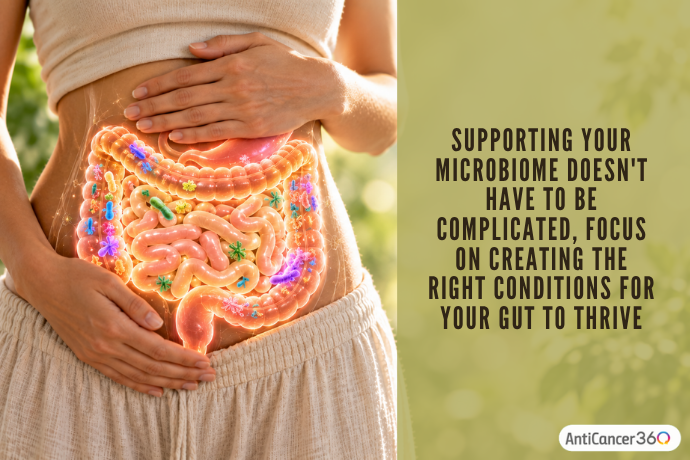
At this point, there is no commercially available microbiome test that can hand every person with cancer a definitive list of bacteria they need to add or eliminate, and there is no single food or supplement proven to create an ideal cancer-fighting microbiome. Nutrition trends, foods, vitamins, and supplements have also not been proven to cure cancer, prevent recurrence, or replace established treatment.
What we can do is work with the evidence we have.
When your treatment and digestion allow it, eat a variety of fiber-containing plant foods. Consider safe fermented foods if they fit your diet and immune status. Be more thoughtful—not necessarily more enthusiastic—about probiotic supplements. Use antibiotics appropriately rather than fearfully. And allow these recommendations to change when your body or treatment changes.
Supporting the gut is just one part of a broader approach to cancer treatment recovery. Understanding how the body manages inflammation and cellular debris after treatment is another important consideration.
A rainforest does not become resilient because someone planted one perfect tree.
It is supported by the conditions that allow the whole ecosystem to thrive.
Frequently Asked Questions
What is the gut microbiome?
The gut microbiome is the community of bacteria, viruses, fungi, and other microorganisms that live primarily within your digestive tract. These microbes interact with food, the intestinal lining, metabolism, and immune function. Each person’s microbiome is somewhat different, which is one reason there is no single definition of a “perfect” microbiome.
Can the gut microbiome affect cancer treatment?
Possibly, and this is an active area of cancer research. Human studies have found associations between certain microbiome characteristics and response to some treatments, particularly immune checkpoint inhibitors. However, this does not mean researchers can yet manipulate the microbiome in a predictable way to improve treatment outcomes across cancers [5].
How much fiber should I eat during cancer treatment?
There is no single fiber target appropriate for everyone receiving cancer treatment. General cancer-prevention guidance recommends about 30 grams per day from food, but diarrhea, bowel surgery, GI radiation, obstruction risk, appetite changes, and difficulty maintaining weight can all change your needs. Your oncology team or dietitian can help individualize the amount [6].
Should I take a probiotic if I have cancer?
Do not assume that a probiotic supplement is automatically beneficial. Effects vary by strain and clinical situation, and people who are immunocompromised or have a central venous catheter may face additional risks. Ask your oncology team before beginning a probiotic supplement during treatment.
Are fermented foods safe during chemotherapy?
They may be for some people, but safety depends on the product and your immune status. Pasteurized commercial products may be appropriate in some situations, while unpasteurized, home-fermented, or certain live fermented foods may be discouraged when infection risk is high. Follow the food-safety recommendations provided by your oncology team.
Can I rebuild my microbiome after antibiotics?
The gut microbiome often changes after antibiotics and can recover over time, but there is no proven universal “reset” protocol. Eating a varied diet as tolerated may support the gut ecosystem. Do not automatically start a probiotic after antibiotics, particularly during cancer treatment; whether a specific product is useful depends on your situation.
One Place to Start
Instead of trying to overhaul your microbiome, start by looking at the plant foods you already tolerate.
This week, add one new fiber-containing plant food to your usual rotation—a different vegetable, fruit, whole grain, bean, lentil, nut, or seed. If treatment has changed what you can comfortably eat, ask your oncology dietitian or care team what type of dietary variety is appropriate for you right now.
This article is for educational purposes and is not a substitute for individualized medical or nutrition advice. Cancer treatments, immune status, medications, and gastrointestinal conditions can change what foods and supplements are appropriate for you. Discuss significant dietary changes and probiotic or other supplement use with your healthcare team.
Which describes you best?
Please select one of the options below, and you'll be guided to the online training that best fits your situation.

I'm fighting an advanced (or late stage) cancer and I'm determined to "beat the odds."

I'm fighting an earlier staged cancer, and want to maximize the outcome & minimize the side effects.

Samantha is a registered nurse, and Integrative Health Coach with Anticancer360. She holds a Bachelor of Science in Nursing from the University of Tulsa, and brings a unique blend of clinical expertise and whole-person care to support our clients along their healing journeys. She has spent the past 15 years as a registered nurse and clinical case manager at UCLA, where her work has been deeply rooted in oncology care.