When researching anticancer supplements, it’s natural to ask: What’s the best one? And it’s totally understandable. When you’re dealing with something as serious as cancer, especially advanced cancer, you want the “strongest thing” you can find.
But that question has a mistake built into it, and this mistake is a pitfall for a lot of people. It treats anticancer substances like a leaderboard — as if there’s a single strongest one. But as you’ll see throughout this article, that’s not really how any of this works. And there are two main reasons for this, which we’re going to unpack in this article.
The first: cancer isn’t one disease. Two tumors can run on completely different fuel and operate from completely different signals. A tool that fits one may do nothing in another — and sometimes, it can make things worse.
The second: cancer adapts. Hit it hard from one angle and it often reroutes its survival strategies. That’s why even the right single tool tends to stop working, and why the real skill is combining tools to close the escape routes.
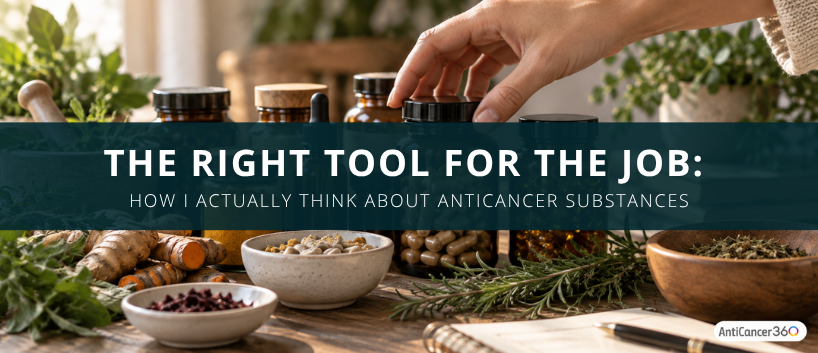
So the useful frame to think about anticancer substances isn’t a leaderboard. It’s a toolbox. A hammer isn’t “better” than a saw — you match the tool to the job in front of you, and a serious job needs more than one. If you got here from my soursop article, this is the line of thinking, where I said soursop is one tool — worth understanding, but only as part of a kit.
Two Kinds of Tools: High Pressure vs. Many Angles
Now before we get into why cancers differ and why they adapt, here’s the frame I carry into every case.
Conventional cancer drugs are one kind of tool. A good targeted drug is dosed to reach a known, effective concentration, and it has a well defined target. The doctors and researchers who build these drugs usually know the exact molecule it hits — and it hits that target hard. So that’s how I think of conventional cancer drugs: high pressure, aimed at one or a few pathways. And when the cancer depends on that pathway, that focused pressure can be extraordinary.
Natural compounds on the other hand, tend to be a different kind of tool. Most are what scientists call pleiotropic — they nudge many pathways at once, more gently, rather than hammering one. There’s an entire research field built on this, called network pharmacology, or polypharmacology (1). And because natural anticancer substances are often gentler, more of them can usually be combined together. So that’s how I think of natural anticancer substances: medium pressure, from many angles at once.
So I don’t think of either as “better or worse.” They’re just different tools for different parts of the job. And the two questions that decide how you use them are: which tool fits this particular cancer, and how many (i.e. which combination) is it going to take.
Part 1: Why the Same Tool Doesn’t Fit Every Cancer
So the first reason why “what’s the best supplement?” is the wrong question, is that cancers are not interchangeable. They differ in what they burn for fuel, and in the signals they run on. Get either one wrong and the strongest tool in the world does nothing.
They Run on Different Fuel
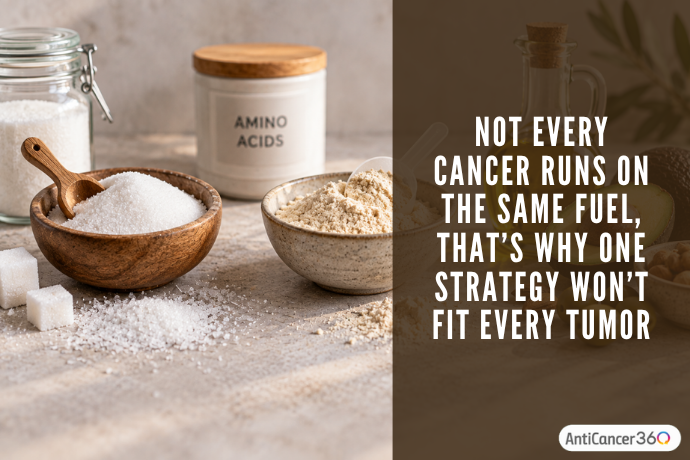
We tend to talk about cancer metabolism as if it’s one thing — most popularly, the “sugar feeds cancer” story. Real tumors are more varied than that. Some are heavily dependent on glucose and the fast, wasteful sugar-burning that Dr. Otto Warburg described a century ago.
Others lean on their mitochondria, the cell’s powerhouse, and burn fuel through oxidation (what’s called OXPHOS). Others are effectively addicted to glutamine, an amino acid, and will wither when it’s cut off while barely noticing a change in sugar (2). And some — like gliomas carrying an IDH mutation — have their metabolism rewired at a deeper level, producing an abnormal metabolite that reshapes how the whole cell runs (3).
Think of it like engines that run on different fuels. Cut off the gasoline supply and you strand every gas-powered car — but the diesel trucks and the electric cars keep right on driving. A tool that starves glucose will pressure a sugar-hungry tumor and barely touch one running on glutamine or fat.
This is exactly why a ketogenic diet isn’t a universal anticancer strategy, even though it’s often promoted as one. Cutting carbs can put real pressure on a glucose-dependent tumor. But some cancers carry the machinery to burn ketones themselves — the enzyme OXCT1 is the rate-limiter — and for those, the ketones a keto diet produces are just another fuel source (4,5). Same diet, opposite fit, depending on the tumor’s metabolism.
And it’s why soursop’s main metabolic angle — jamming the mitochondrial step called Complex I — is a fit for a tumor that’s vulnerable there, and a weaker bet for one that isn’t.
They Run on Different Signals — Sometimes Opposite Ones
So, metabolism is half of the equation. The other half is cell signaling: the molecular messages a cancer depends on to grow. And here the mismatches get sharper, because some cancers depend on opposite things.
Let’s start with the clearest case. A hormone-receptor-positive breast cancer runs on estrogen signaling — it’s part of what feeds it. A triple-negative breast cancer has none of those receptors and runs on something else entirely. So a compound that behaves like estrogen is playing with fire in the first group and largely irrelevant in the second.
And that’s not hypothetical. Resveratrol for example, one of the most well-known anticancer supplements, can act as an estrogen-receptor agonist. This means that in a hormone-driven breast cancer, there’s a real concern that resveratrol could feed the disease rather than slow it down (6). The same compound, opposite consequences, depending on the cancer’s biology.
The same logic runs through the targeted-drug world. Lung cancers driven by an EGFR mutation, a KRAS mutation, and an ALK fusion each need a different drug aimed at that specific driver. Give the EGFR drug to the KRAS-driven cancer and you get nothing.
Another example of this need for individualization is redox — the balance between oxidation and antioxidant defense. We’re told antioxidants are universally protective. But with cancer, that can be exactly backwards.
In animal studies, giving antioxidants like N-acetylcysteine and vitamin E accelerated lung cancer progression and shortened survival (7), and antioxidants increased melanoma metastasis (8). The reason is that some tumors are held in check by their own oxidative stress, and mopping it up removes the brakes.
Meanwhile other cancers, especially ones with high activity of a mechanism called NRF2, are already good at defending themselves against oxidation — and handing them more antioxidants can shore up that defense. So a blanket “antioxidants are good for cancer” can, in the wrong tumor, help the wrong side.
Put both halves together and the conclusion is simple: “here’s a list of the best anticancer supplements” is a poor way to think about any of this. The right tool is defined by the specific cancer — what it burns and what it runs on. Individualization isn’t a side thought that I tack on at the end. It’s the foundation.
So that’s how I think of the “which tool?” problem. But there’s a second problem, and it shows up even when you’ve picked exactly the right one.
Part 2: Why One Tool Usually Isn’t Enough
Say you match the tool to the biology perfectly. Here’s what tends to happen next: it works for a while, and then the cancer finds a way around it. This isn’t a failure of the tool. It’s the ability of cancers to adapt — and understanding this is why I think of anti-cancer compounds in combinations.
Oncology Already Proved This
I want to base this on conventional medicine’s own research first, because it’s not alternative-medicine wishful thinking. It’s how modern oncology is trying to fight cancer, and the evidence is about as solid as evidence gets.
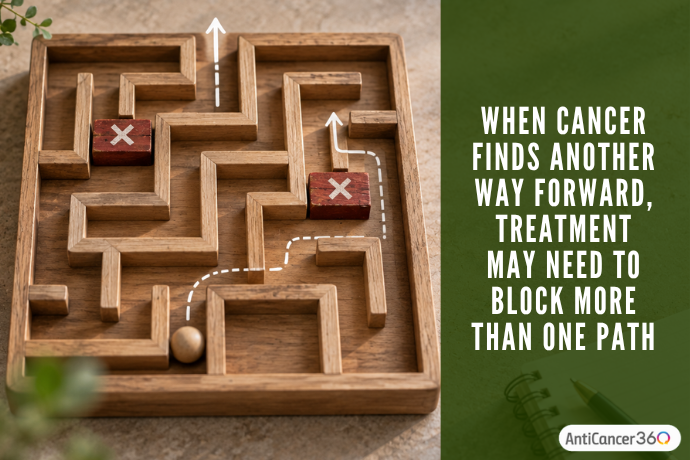
The cleanest example is BRAF-mutant melanoma. There’s a drug that blocks the mutated BRAF protein, and on its own it works — impressively, at first. Then the cancer reactivates the same growth pathway just downstream of where the drug is blocking, and the disease comes back.
So oncologists added a second drug that blocks that downstream step, called MEK. Blocking both BRAF and MEK together clearly outperformed blocking BRAF alone. That meant longer control of the disease and longer survival in randomized trials (9). That’s two tools working together — the second drug closes the escape route the cancer used to slip past the first drug. So the combination keeps working when either one alone would fail.
Lung cancer tells the same story from a different angle. Cancers driven by an EGFR mutation respond to EGFR-blocking drugs — until many of them reroute by ramping up a different growth receptor called MET, and grow right through the block. The response to that has been to target both at once (10). Block one road, the tumor takes the detour; block the detour too, and it’s stuck.
Picture whack-a-mole. Cover one hole and it pops up in the next. Cover the holes together, and there’s nowhere left to go. That’s the principle, and oncology validated it the hard way, in people, with drug-plus-drug combinations.
Extending the Principle to Natural Tools
So here’s where I extend this line of reasoning. If single-pathway pressure breeds escape, then covering many angles at medium pressure — which is what natural compounds do — is a rational way to make those escape routes harder to use. Especially when the natural approach is layered alongside the high-pressure conventional drug, not in place of it.
But I’ll hold my thinking to the same standard I’d hold anyone else’s evidence to. The strongest proof that combinations prevent resistance comes from drug-plus-drug studies like the ones above. Extending that logic to natural-plus-conventional, or to stacking natural compounds together, is a sound rationale. But it is not the same thing as proven fact. This is why I say that our approaches are experimental, and most appropriate for the most difficult cases.
And the broader caution I constantly remind people about: only about one in ten things that work in the lab or in animals end up working in people (11). So take this as the logic behind how I think, not a promise about outcomes.
Part 3: Natural Polypharmacy — Many Gentle Tools, Chosen to Fit
So if conventional medicine combines a few high-pressure drugs, the natural side of the toolbox works a little differently: you combine several medium-pressure tools, each chosen to cover a different angle. This is where the “medium pressure, many angles” profile actually pays off — and it’s why, with natural approaches, the combination is usually the intervention.
Because, one or two natural anticancer substances alone, rarely move the needle. The lab literature also backs this thinking. Take two of the most-studied plant compounds, curcumin (from turmeric) and EGCG (from green tea). Against tumor blood-vessel growth in a colorectal model, each one alone helped only modestly — but together they suppressed the blood supply far more than either did on its own, by shutting down a signaling route neither could fully close by itself (12).
That’s an example of this line of thinking: two medium tools, aimed at the same problem from different directions, adding up to more than the sum of their parts. The broader research is full of these phytochemical combinations, where the mix outperforms the single agent across different models (13). It’s all preclinical (i.e. petri dish and animal studies). So it’s far from conclusive — but the pattern is real and consistent.
Overall, there are really two broad types of combinations to consider:
- Same pathway, two points on it — like BRAF plus MEK. You block the road and its immediate detour. So, more vertical.
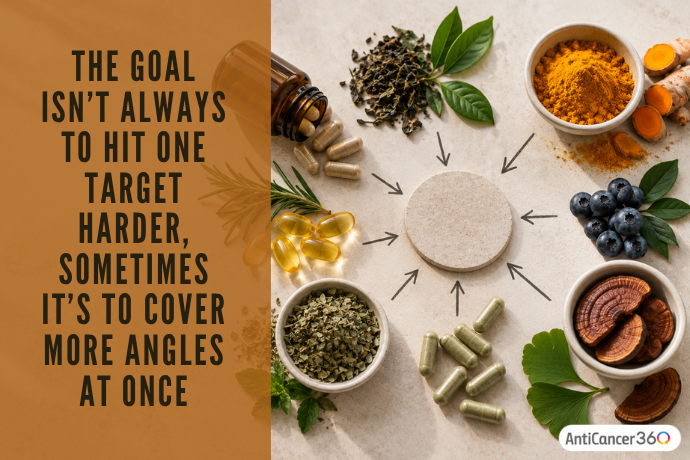
- Different pathways at once — metabolism here, programmed cell death there, blood-vessel growth over there. You cover multiple systems so that shutting down any one of them isn’t enough for the cell to survive. So, more horizontal.
Natural polypharmacy leans horizontal. We’re not trying to hit one target harder than a drug could — we probably can’t with natural compounds. We’re trying to cover more of the board at once, gently, in a way the cancer can’t easily route around. And perhaps the biggest advantage? It’s that natural anticancer compounds are usually much more gentle than pharmaceutical compounds. So this lets us combine many more without causing unbearable side effects, like you would often see when combining many pharmaceutical drugs.
There’s a nice irony hiding in this, too. A whole botanical is already a combination — dozens of compounds acting together, not one purified molecule. It’s nature’s own polypharmacy. That’s part of why a whole-plant extract and an isolated compound from the same plant can behave so differently, and it’s something we’ll talk about in another article.
The field has a name for all of this — network pharmacology — and a growing body of work mapping how multi-target, nature-derived combinations might be designed on purpose rather than by luck (14). We may be early. But the logic is coherent, and it lines up with how the most treatment-resistant cancers actually behave.
How I Actually Choose
So how does this become a decision instead of a philosophy? Well I do this in four steps.
Read the biology. What does this particular cancer appear to run on — what fuel, which driver signals? That’s how we rule things in or out before anything else.
Match tools to the gaps. Pick compounds whose mechanisms fit this cancer’s vulnerabilities and cover angles the conventional treatment isn’t already covering.
Combine to close the escape routes. Not the single “strongest” thing — a thoughtful combination, leaning on the many-angles logic, so the cancer has fewer ways to adapt.
Run it alongside conventional care, in the harder cases, under real supervision. This kind of experimental, science-guided layering makes the most sense when conventional options are narrowing — where the risk-reward actually favors being more experimental — not as a first move in an early, highly treatable cancer. (How aggressive to get for a given case is its own decision, and I’ve mapped that out separately — plotting the odds of complete remission against five-year survival on conventional treatment alone to place where someone sits on the spectrum.)
And one important caution that I have to emphasize again: not every combination is synergistic. Some combinations do nothing extra. Some actively work against each other — one compound blunting another, or an antioxidant softening a treatment that was supposed to rely on oxidative stress.
Some just stack up side effects or interact with the drugs. “More tools” is not automatically “better.” Combining well takes knowing the specific cancer, the specific compounds, and everything else the person is taking — which is exactly why this should be done with a practitioner who can see the whole picture. Herb-and-drug interactions are also real, so combining more anticancer substances together increases the risks.
The Bottom Line
There is no “best” anticancer substance, any more than there’s a single best tool in a toolbox. There’s the right tool for this cancer — matched to what fuel it burns and what it runs on — and the right combination to keep it from adapting to treatments. Conventional medicine brings high pressure from a few angles. Natural approaches bring medium pressure from many. The best chances of benefits comes from combining them thoughtfully, individualized to the person and the cancer type, alongside conventional care rather than instead of it.
That’s a less satisfying answer than a single miracle supplement. But it’s the true one, from my perspective.
If you take one thing from this article: stop asking which supplement is the best, or strongest. Start asking which tools fit this specific cancer, and which combination covers its escape routes.
Frequently Asked Questions
Is there a single best anticancer supplement? No. Cancers differ in what they run on, so a compound that fits one may do nothing in another — and cancers adapt more easily around single agents, so well-designed combinations usually matter more than any one item. The useful question is which tools fit the specific cancer, and which combination covers its escape routes.
Why do oncologists combine cancer drugs? Because blocking a single pathway hard tends to select for cancer cells that reroute around it. Combinations — like blocking both BRAF and MEK in melanoma — close the escape routes and work longer than a single drug alone.
Can natural compounds actually work together (synergy)? In the lab, yes — combinations of plant compounds such as curcumin and EGCG have outperformed either one alone in preclinical models. Whether that translates to people is far less certain, and it’s best considered alongside conventional care, under supervision.
Why might a supplement help one cancer and not another? Because cancers differ in fuel (glucose, glutamine, fat) and in driver signals (for example, hormone-driven versus not). A tool matched to the wrong biology can be useless — and occasionally, as with estrogen-like compounds in hormone-driven cancers, may be harmful.
Can combining supplements be harmful? Yes. Not every combination helps — some do nothing extra, some interfere with each other, some add side effects, and some interact with medications. “More” isn’t automatically “better,” which is why individualization and practitioner oversight matter.
Disclaimer
⚖️ This content is for educational purposes only and reflects clinical observations and emerging research. It is not medical advice and is not intended to diagnose, treat, cure, or prevent any disease. The methods discussed are experimental and are generally most appropriate for advanced cases where conventional treatments have limited proven benefit. They should be considered alongside, not instead of, conventional medical care, and only under the supervision of qualified medical professionals familiar with your specific case. Individual results vary. Anticancer360 does not replace your oncologist or primary care team. Always consult your treating physicians before making changes to your treatment plan, diet, or supplement regimen.
Which describes you best?
Please select one of the options below, and you'll be guided to the online training that best fits your situation.

I'm fighting an advanced (or late stage) cancer and I'm determined to "beat the odds."

I'm fighting an earlier staged cancer, and want to maximize the outcome & minimize the side effects.
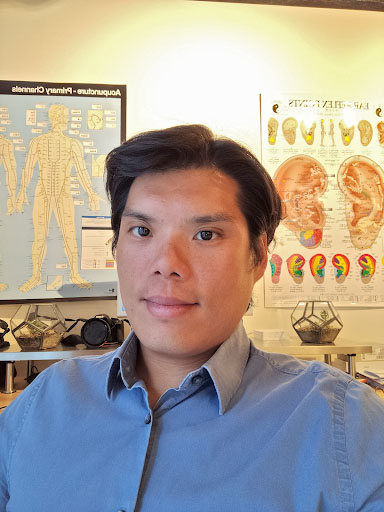
Gene Wei is a Board Certified Doctor of Oriental Medicine in the state of Florida, and the founder of AntiCancer360. He’s also a graduate of the University of California Los Angeles, and East West College of Natural Medicine.
His practice focuses on aggressive integrative strategies used alongside conventional oncology care, particularly for advanced and difficult cancers.