If you spend any time researching cancer, you’ll run into the headline constantly. “This compound destroys cancer cells.” “Turmeric kills cancer in the lab.” “This extract wiped out tumor cells in a study.” And when you’re dealing with something as serious as cancer, claims like this can really grab your attention, because they sound like exactly what you’re looking for.
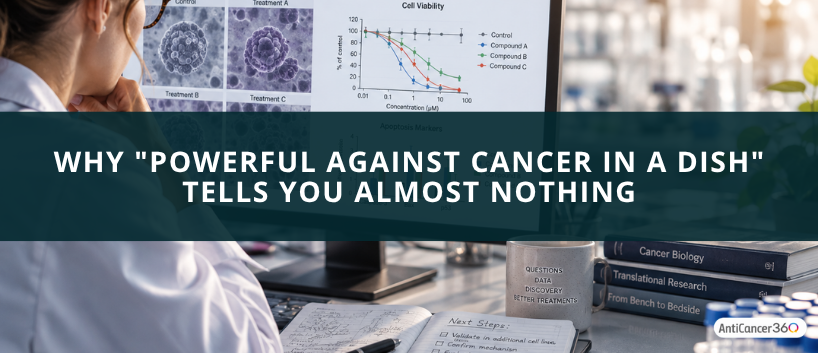
So I want to save you a lot of false hope and wasted money, but give you some real hope as well. First, almost every one of those headlines comes from a dish study — cancer cells grown in a petri dish, with the compound poured directly on top. And here’s the uncomfortable truth: a compound killing cancer cells in a dish tells you almost nothing about whether it does anything in a person.
But I’m not saying these studies are worthless either. They are useful leads. But problems arise when they get sold as solutions, rather than leads. So in this article I’ll show you why “powerful in a dish” is a weak signal, what a compound actually has to survive to matter in a real body, and — by the end — the exact questions to ask the next time you see one of these claims.
The One Analogy That Makes This Click: A Dish Is Not a Sponge
Here’s the mental model I want you to think about.
Think about bleach. Pour bleach on cancer cells in a flat dish and it will wipe them out completely. Every cell is sitting right there on the surface, fully exposed, soaking in as much bleach as you want to add, for as long as you want. You can sterilize a dish.
Now try to sterilize a kitchen sponge with that same bleach. You can’t — not really. The sponge is a three-dimensional maze. The bleach can’t reach every pocket. The gunk inside soaks it up and neutralizes it before it gets deep. Bacteria survive in the interior where the concentration never gets high enough. Same bleach, same starting strength — but the flat surface gets sterilized and the sponge doesn’t.
A tumor is a sponge, not a dish. It’s a dense, three-dimensional mass with a chaotic, leaky blood supply and high pressure inside that actively pushes substances back out. A compound that kills every cell in a flat dish may only reach the outer rim of a real tumor, at a small fraction of the concentration that worked in the lab. The concentration on the surface is not the concentration that gets delivered to the depths.
That single example explains most of the gap between “works in a dish” and “works in a person.” Let’s walk through why.
The Dish Is a Best-Case Stage
Start with how these experiments actually run, because the setup is stacked in the compound’s favor every step of the way.
The compound is purified — the single most active molecule, concentrated. It’s applied directly to the cells, so a hundred percent of the dose reaches them. It’s usually held at a high, fixed concentration, bathing the cells continuously for many hours, often days. And the cells are growing on a flat surface, with nothing around them — no gut, no liver, no bloodstream, no immune system, no distance to travel.
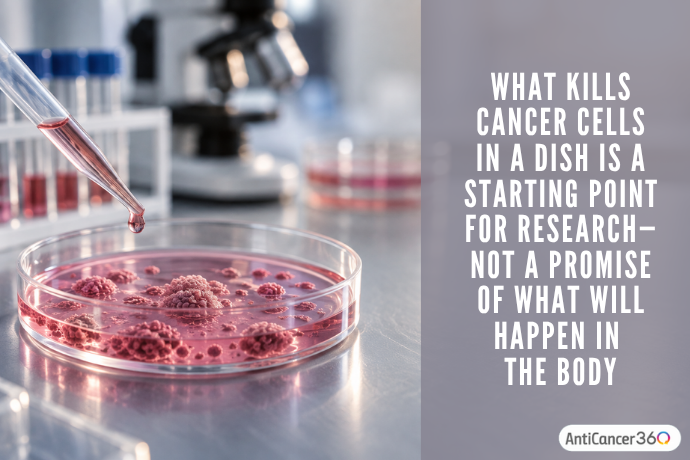
None of that is how a substance behaves once you swallow it. So a dish result isn’t a promise. It’s a hypothesis — “this molecule can kill this kind of cancer cell under ideal conditions.” Whether it can do that inside a living person is a completely separate question, and it’s the harder one.
The Gauntlet: What a Compound Has to Survive to Matter in a Body
Between the pill you swallow and a cancer cell dying inside a tumor, there’s a gauntlet. A compound has to clear every stage. Most natural compounds fall down at the first one.
First, it has to be absorbed. Swallowing something doesn’t mean it gets into your blood. The classic example is curcumin, the active compound in turmeric — one of the hyped-up “anticancer” substances on the internet. In reality, curcumin is notoriously hard to absorb. It’s poorly soluble, and most of what you swallow simply never makes it into the bloodstream [1].
Second, it has to survive metabolism. Whatever does get absorbed runs straight into the liver, which is built to chemically tag foreign molecules and mark them for disposal. Resveratrol — the red-wine compound — is the textbook case. People absorb it reasonably well, but the body transforms and clears it so fast that the amount of free, active resveratrol left in the blood is extremely low [2]. What’s absorbed is not the same as what’s available.
Third, it has to actually reach the tumor. This is the sponge problem, and it’s real pharmacology, not a metaphor. Even proper chemotherapy drugs — engineered specifically to get into tumors — struggle to penetrate a solid tumor evenly, because of that poor blood supply and the high pressure inside the mass [3]. A gentle plant compound at a low blood concentration is fighting the same headwind, usually with far less potency behind it.
Fourth — and this is the one that ends most of the hype — the concentration has to be reachable. This is where you do the math nobody in the headlines does. Take the concentration that killed the cells in the dish, and ask: could a human safely reach that level in their blood, let alone inside a tumor? For a lot of these compounds, the honest answer is no. You’d have to swallow an impossible amount, or a toxic one. The dish study worked at a concentration a body may not ever be able to reach.
Fifth, it has to stay long enough. The dish studies often bathe those cells for two or three days straight. A real dose spikes in your blood and then falls as your body clears it. What matters is how long the level stays above the threshold where anything happens — and for most oral compounds, that window is short and shallow.
Clear all five and you might have something. Fall at any one and the dish result stays exactly what it was: a result in a dish.
So How Often Does “Works in the Lab” Become “Works in People”?
You’d think, given how much lab research exists, that a decent share of it pans out. The reality is that it usually doesn’t, and this is important to understand.
Even for compounds that make it all the way through animal studies, only about one in ten end up working in humans — and by some analyses, fewer [4]. That’s the figure I come back to over and over in our articles, because it’s the honest reality.
And that’s just the animal-to-human step. Cancer specifically has the worst track record in all of medicine: of the cancer drugs that make it into human trials, only about 3 to 4 percent ever get approved [5] — and those had already survived the dish and the animal stages before a single person took them.
Here’s the part that matters for supplements. There isn’t a clean published number for “what fraction of dish results work in humans.” But the logic is solid: the dish is a filter that comes before the animal filter, and most petri dish findings hit dead ends long before anyone runs an animal study, let alone a human one.
So dish-to-human is definitely worse than one in ten. And remember — the drugs in that grim 3-percent figure were built to be absorbed. Most natural compounds start the race with worse bioavailability than a purpose-built pharmaceutical. The deck is stacked against a random “kills cancer in a dish” headline before it even begins.
What Actually Has to Be True — and How to Read the Next Anticancer Headline
So here’s what I want you to remember from this article.
For a compound to matter in a real person, the whole chain has to hold: it has to be absorbed, survive the liver, reach the tumor, and stay there long enough — and the concentration a human can safely reach has to actually overlap the concentration that did something in the lab. That last overlap is critical, and it’s what the headlines never mention.
So whenever you read a “this kills cancer cells” claim… you have to ask yourself three questions:
First, was it just a dish? If it’s cells in a petri dish, it’s a hypothesis, not evidence of benefit in people.
Second, at what concentration — and can a human reach it? A result at a concentration no human blood could safely hit is a lead that needs to get investigated further, not a treatment.
Third, would it even reach the tumor? Absorbed, un-metabolized, delivered into a dense mass — or does it fall down the gauntlet somewhere?
This Is Exactly Why Formulation and Combinations Matter
Now, none of this means natural compounds are hopeless either. It just means the naive version — “it’s strong in a dish, so I’ll take it” — is short-sighted. The gap is real, but parts of it can be engineered around, and that’s a lot of what thoughtful integrative practice actually is.
Some of it is delivery and formulation. The curcumin absorption problem, for instance, is partly solvable: pairing curcumin with piperine, a compound from black pepper, was shown to raise its bioavailability dramatically in one well-known study [6]. Absorption-enhanced and standardized forms exist for exactly this reason. The molecule didn’t get stronger — we just got more of it across the gauntlet.
And some of it is about combining tools — polypharmacy. This is where it ties back to how I think about all of this. If no single oral compound reaches “dish levels” inside a tumor, then leaning on one “strongest” compound is the wrong move.
A more rational move is to determine a thoughtful combination of several gentler compounds. Each compound can reach the tumor partially, covering a different angle, and sometimes working together so that lower concentrations of each might be enough. This is how we work around the delivery problem, rather than betting everything on one molecule that can’t get there alone [7,8].
It’s still emerging research, and still preclinical for the most part [9]. But it’s a coherent answer to a real limitation. This is also why I almost never think in terms of a single substance. (I’ve laid out that whole framework in its own piece — the right tool for the job.)
A Signal That These Compounds Do Reach the Tumor
Fair question at this point: if the gauntlet is that brutal, do oral natural compounds ever reach a tumor and do anything at all? In my clinical experience, alongside conventional treatment, I think the answer is sometimes yes — and sometimes you can almost watch it happen in real time.
Over the years, working alongside conventional care, I’ve seen cases where a tumor you could actually feel (a breast tumor for example) would swell noticeably within a day or two of starting or changing a supplement combination, and then settle back down.
Now, with changes that fast, that’s almost certainly not the cancer growing — real tumor growth doesn’t happen overnight. What it looks like is inflammation and immune activity around cells that are dying off.
Conventional oncology has a documented version of this, by the way: it’s called pseudoprogression, where a tumor appears to grow on a scan because the immune system has flooded in, before it then shrinks [10]. There’s even research showing that dying cancer cells can send out their own signals — first described in radiation therapy — which is partly why “how you kill the cancer” matters, not just whether you kill it [11].
I want to be careful here. Because, this is an observation, not proof, and I’m describing it as something I’ve seen happen alongside conventional treatment — not as a promise about what will happen in any particular case. For every case where something visible moved, there are others where we added the same things and nothing changed. But taken together, signals like that are part of why I don’t accept the flat claim that oral compounds “never reach the tumor enough.” Sometimes, clearly, they do.
That observation cuts two ways, though — because if you can provoke that much die-off, the pace of it starts to matter. Too much, too fast has its own risks.
Holding My Own Tools to the Same Standard
Now, I always try to be balanced in my perspective. So I’ll apply some healthy skepticism to my own line of thinking, not just hype things up.
Because everything I just told you about dish studies applies to the compounds I use as well. Soursop’s headline potency (10,000x stronger than chemo) is a dish number. For things like curcumin, EGCG, and most of the plant compounds I find promising — the evidence is largely cells and animals, not human trials. If I’m going to teach you to distrust a “kills cancer in a dish” claim, I have to hold my own thinking to the same bar.

So this is why I care so much about bioavailability, about standardized and absorption-enhanced forms, about combining compounds instead of chasing one, and about using all of it alongside conventional care rather than instead of it.
It’s also why I keep emphasizing that these approaches are experimental, and are most appropriate for advanced cases where conventional options are narrowing. A dish result doesn’t earn a spot in someone’s plan on its own. It earns a closer look.
The Bottom Line
“Powerful against cancer in a dish” is a starting signal, not a verdict. It’s not proof… but it’s not worthless either. It’s a reason to investigate and maybe test, nothing more. The real questions were never “how strong is it in a dish” or “which single compound is the most powerful.” The better questions to ask are, if it can actually get to the tumor at a high enough level, for long enough — and where does it fit alongside everything else.
That’s a less exciting answer than a miracle supplement headline. But it’s the one that respects both the science and your attention. Match the tool to the job, get it to where it needs to go, and combine wisely — that’s where we find the greatest potential for benefit. Not in the potency from a petri dish study.
Frequently Asked Questions
A study says a compound “kills cancer cells” — does that mean it works against cancer? Not on its own. Almost all of those studies are done on cancer cells in a dish, where the purified compound is poured directly onto fully exposed cells at high concentration. That shows the molecule can kill cells under ideal conditions — it doesn’t show it can reach a tumor in a living body at a meaningful level. Treat it as a hypothesis, not evidence of benefit in people.
Why doesn’t potency in a dish translate to a real body? Because a swallowed compound has to be absorbed, survive the liver, travel to the tumor, penetrate a dense three-dimensional mass, and stay there long enough — and it has to reach, safely, the same concentration that worked in the dish. Most compounds fail one of those steps. A flat dish can be “sterilized”; a tumor, like a sponge, can’t be affected in the same way.
Does this mean supplements are useless against cancer? No. It means the naive version — “it’s strong in a dish, so I’ll take it” — is useless. Parts of the gap can be engineered around with better-absorbed, standardized formulations, and by combining various compounds together thoughtfully, rather than relying on one. These remain experimental approaches, best used alongside conventional care under supervision.
How can I tell if a “kills cancer” claim is meaningful? Ask three things: Was it just cells in a dish? At what concentration — and could a human safely reach that level? And would the compound even reach a tumor after being swallowed and processed? If a claim can’t survive those questions, it’s a lab curiosity, not a treatment.
I heard turmeric fights cancer — but also that it’s barely absorbed. Which is true? Both. Curcumin shows genuine activity in the lab, and it’s also notoriously poorly absorbed when swallowed. That’s exactly why formulation matters — pairing it with piperine from black pepper, or using absorption-enhanced forms, can raise how much actually gets into the blood. Even then, it’s emerging research, not a proven cancer treatment.
Disclaimer
⚖️ This content is for educational purposes only and reflects clinical observations and emerging research. It is not medical advice and is not intended to diagnose, treat, cure, or prevent any disease. The methods discussed are experimental and are generally most appropriate for advanced cases where conventional treatments have limited proven benefit. They should be considered alongside, not instead of, conventional medical care, and only under the supervision of qualified medical professionals familiar with your specific case. Individual results vary. Anticancer360 does not replace your oncologist or primary care team. Always consult your treating physicians before making changes to your treatment plan, diet, or supplement regimen.
Which describes you best?
Please select one of the options below, and you'll be guided to the online training that best fits your situation.

I'm fighting an advanced (or late stage) cancer and I'm determined to "beat the odds."

I'm fighting an earlier staged cancer, and want to maximize the outcome & minimize the side effects.
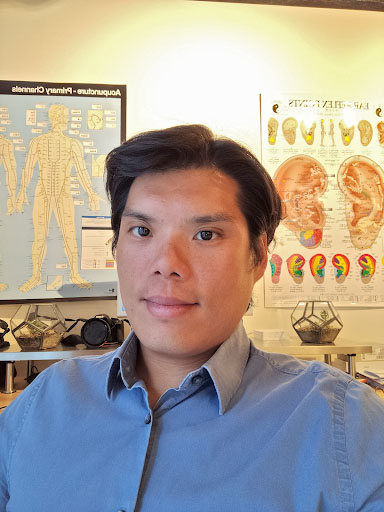
Gene Wei is a Board Certified Doctor of Oriental Medicine in the state of Florida, and the founder of AntiCancer360. He’s also a graduate of the University of California Los Angeles, and East West College of Natural Medicine.
His practice focuses on aggressive integrative strategies used alongside conventional oncology care, particularly for advanced and difficult cancers.