
Cancer can make it difficult to ever feel fully settled.
There are appointments, treatments, scans, symptoms, decisions, and the uncertainty of what comes next. Even when nothing particularly stressful is happening in the moment, you may notice that your body still feels tense, restless, alert, or unable to completely relax.
This does not mean stress caused your cancer, and it certainly does not mean you need to become perfectly calm in order to heal. Stress is a normal physiological response, and during something as significant as cancer, there are very real reasons your body and mind may remain more alert than usual.
A nervous system reset doesn’t mean eliminating stress—it means giving your body opportunities to shift out of a heightened stress response and recover.
In this article, we’ll look briefly at why the body can remain activated even after a stressful moment has passed, and more importantly, explore three simple ways you can begin supporting your nervous system: slow breathing, gentle movement, and mindfulness.
Key Takeaways
- Stress is a normal biological response designed to help your body respond to challenges. The goal is not to eliminate it.
- Cancer can create repeated physical and emotional stressors, which may make it harder to fully shift out of a state of heightened alertness.
- Stress-management practices may support anxiety, fatigue, sleep, and quality of life, but they should not be viewed as treatments for cancer itself.
- Mindfulness-based interventions have some of the strongest evidence in people with cancer, with clinical guidelines supporting their use for anxiety during and after treatment.
- A nervous system reset doesn’t require an hour-long wellness routine. A few intentional minutes of breathing, movement, or mindfulness can be a realistic starting point.
At AntiCancer360, we work with people navigating not only cancer treatment itself, but everything that comes with it—the uncertainty, changing routines, difficult decisions, physical symptoms, and emotional weight. Understanding the stress response can help you work with your body rather than feeling as though you need to fight against it.
The Problem Isn’t Having Stress—It’s Not Having Enough Opportunities to Recover
Your body is designed to respond to stress.
Imagine walking through the woods and suddenly seeing a bear. Before you have time to consciously think through what is happening, your body begins preparing you to respond. Your heart beats faster, your breathing changes, blood pressure rises, and glucose becomes available for quick energy. Stress hormones such as adrenaline and cortisol help mobilize the resources you might need to respond to danger.
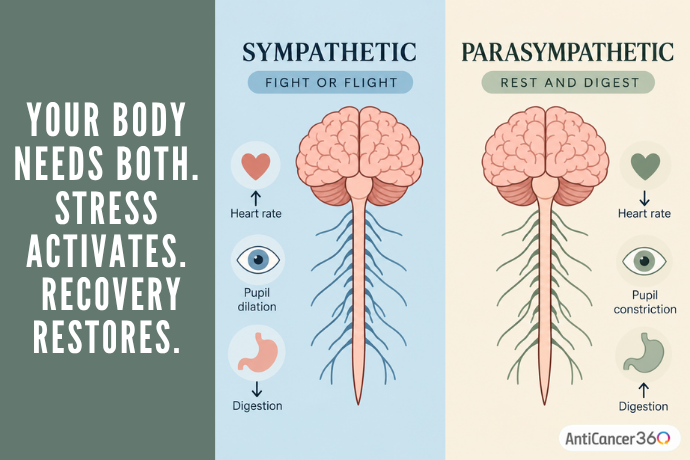
This response involves the autonomic nervous system, which helps regulate processes you don’t have to consciously control, including heart rate, breathing, blood pressure, and digestion.
The sympathetic branch of this system helps mobilize the body during challenge or threat, while the parasympathetic branch supports processes associated with rest, digestion, and recovery. Neither state is inherently good or bad. Your body is designed to move between them depending on what the moment requires.
The problem isn’t stress itself. The challenge is when there are too few opportunities to recover from it.
Cancer can create exactly that kind of environment.
A scan may be over, but now you’re waiting for the result. Treatment ends for the day, but you’re wondering how you’ll feel tomorrow. You receive good news, but part of you may already be thinking about the next appointment.
Unlike the bear that eventually disappears into the woods, the uncertainty associated with cancer does not always have a clear endpoint. That can make it understandably difficult for the mind and body to fully settle.
You Don’t Need to “Calm Down”—You Need Ways to Come Back
Learning about the physical effects of stress can sometimes create a new worry: Now I’m stressed about being stressed.
That is the opposite of what this information should do.
Feeling anxious, frightened, angry, or overwhelmed after a cancer diagnosis does not mean you are doing something wrong. Current evidence also does not justify telling someone that reducing psychological stress will prevent cancer recurrence or improve survival.
A more useful goal is to create opportunities for recovery.
Instead of asking, “How do I stop being stressed?” it may be more helpful to ask, “What could help my body settle a little right now?”
Sometimes that may be your breath. Sometimes it may be movement. Other times it may simply mean bringing your attention back to what is happening in the present rather than following your mind into every possibility that could happen tomorrow.
These practices are not cancer treatments. However, evidence-based approaches including mindfulness, structured physical activity, relaxation techniques, and psychological interventions can help support symptoms such as anxiety, depression, fatigue, and quality of life in people living with and beyond cancer.
Here are three simple places to begin.
Reset #1: Slow Your Breathing for Five Minutes
Your breath is unusual because it happens automatically, but you can also intentionally change it. That gives you one accessible way to interact with the physiological stress response.
When you are anxious, breathing may become quicker or shallower. Intentionally slowing the breath is commonly incorporated into relaxation and mind-body practices designed to reduce physiological arousal.
This doesn’t require taking enormous “deep breaths.” In fact, forcing the breath can sometimes feel uncomfortable. Instead, think about allowing your breathing to become slower and more comfortable.
Try This: Five Minutes of Slower Breathing
Find a comfortable position sitting or lying down and allow your shoulders to soften as much as they comfortably can.
Take a gentle breath in through your nose, then allow the breath to leave slowly. Rather than worrying about getting the timing exactly right, simply let your breathing become a little slower than usual. If it feels comfortable, allow the exhale to last slightly longer than the inhale.
You can continue this for three to five minutes. If counting helps you focus, try gently inhaling for about four seconds and exhaling for five or six seconds. The count is not the important part, so return to your normal breathing if you experience dizziness, air hunger, or discomfort.
You can also make the practice much shorter. Three slower breaths before walking into an appointment, a few minutes while sitting in the car before treatment, or five minutes before bed all count.
The purpose is not to make anxiety disappear. It is simply to give your body a few moments of a different experience.
Reset #2: Use Gentle Movement to Help Your Body Shift States
When stress builds, staying completely still is not always what the body needs. Movement can be another way to support both physical and emotional well-being during cancer treatment.
Research from randomized clinical trials supports appropriately tailored aerobic and resistance exercise during and after cancer treatment. Depending on the population and type of exercise studied, benefits may include improvements in fatigue, physical function, strength, fitness, anxiety, depression, and quality of life.
That does not mean you need an intense workout every time you feel stressed.
If your medical team has cleared you for activity, try choosing five or ten minutes of movement that feels manageable that day. You might walk outside or through your home, gently stretch your shoulders and hips, practice a few simple mobility exercises, or put on one or two songs and move in whatever way feels comfortable.
Before you begin, notice how your body feels. Then check in again when you finish.
You are not looking for a dramatic transformation. Maybe your shoulders feel slightly less tense. Maybe your thoughts have slowed down. Maybe you simply feel more present in your body.
And if nothing noticeably changes, that doesn’t mean you did it wrong.
Exercise should always be individualized during cancer treatment. Surgery, anemia, bone metastases, neuropathy, balance problems, cardiovascular conditions, blood counts, treatment side effects, and other factors may change what movement is appropriate.
The purpose isn’t to push through your body. It is to find movement that works with the body you have today.
Reset #3: Give Your Mind Something Safe to Notice
Stress has a way of pulling attention into the future.
You may find yourself wondering what the next scan will show, whether treatment will work, how you’ll feel next week, or whether cancer could return. The mind is trying to anticipate what might happen next, often as an attempt to protect you from uncertainty.
The difficulty is that the body can respond to those thoughts even though the feared event is not happening in the present moment.
Mindfulness offers another option: intentionally bringing attention back to what is happening right now.
This is one of the better-supported mind-body approaches in oncology. Clinical guidelines from the Society for Integrative Oncology and ASCO give mindfulness-based interventions a strong recommendation for improving anxiety symptoms during active cancer treatment and after treatment, based on randomized clinical trial and systematic-review evidence.
Structured mindfulness programs involve much more than a five-minute meditation, but you can still begin practicing the underlying skill at home.
Try This: A Five-Minute Grounding Practice
Set a timer for five minutes and sit somewhere comfortable. You can close your eyes or simply soften your gaze.
Begin by noticing where your body is supported. Feel your feet against the floor, your legs against the chair, or your hands resting in your lap. Then bring your attention to your breathing without trying to change it.
Notice one inhale and one exhale.
Your mind will wander. You may think about treatment, your next scan, something you forgot to do, or what you are making for dinner. Wandering isn’t a sign that you are bad at mindfulness; noticing that it happened is actually part of the practice.
When you notice yourself becoming caught in thought, gently acknowledge “thinking,” and bring your attention back to something happening in the present—your breath, your feet against the floor, a sound in the room, or the feeling of the chair supporting you.
The goal is not to empty your mind or convince yourself that everything is okay. It is simply to practice returning to the moment you are actually in.
Choose the Nervous System Reset That Fits the Moment
You now have three simple options: breathing, movement, and mindfulness.
You do not need to do all three every day. Instead, consider matching the practice to what you notice in yourself.
Before an appointment, a few minutes of slower breathing may feel supportive. When you are restless or stuck in your head, a short walk may help. When your thoughts keep moving into the future, five minutes of grounding may give your attention somewhere else to land.
You can even approach this as an experiment. Before beginning, ask yourself how activated or stressed you feel on a scale from zero to ten. Practice for five minutes, then check again.
Maybe an eight becomes a six. Maybe it becomes a seven. Maybe nothing changes at all.
All of that is information.
Over time, the purpose isn’t to develop a switch that instantly turns stress off. It is to build a collection of practices that can help you respond differently when you notice your body or mind becoming overwhelmed.
Stress Management Is Supportive Care, Not Another Cancer Assignment to Perfect
This may be one of the most important distinctions in the entire conversation.
When people hear that chronic stress affects the body, the information can easily become another source of pressure. You may start thinking you should meditate more, shouldn’t feel so anxious, or need to somehow become better at managing everything you’re going through.
You already have enough to carry.
Stress-management practices are supportive care. They may help with anxiety, fatigue, sleep, mood, and quality of life, but they are not a test of how well you are doing cancer.
You do not need to be calm all day or eliminate difficult emotions. Fear, grief, anger, frustration, and uncertainty are understandable parts of navigating something this significant.
The goal is simply to create moments within all of that when your system has an opportunity to settle.
Sometimes that may be five minutes of breathing. Sometimes it is a walk outside, a quiet moment, or a conversation with someone who makes you feel supported. None of these moments need to be perfect to be worthwhile.
You Don’t Have to Practice Alone
Mindfulness often sounds like something you are supposed to figure out by yourself, but it doesn’t have to be.
Practicing alongside other people can provide structure, connection, and a reminder to intentionally make space for yourself during a week that may otherwise revolve around appointments, treatments, responsibilities, and everyone else’s needs.
That is part of why we created Mindful Mondays at AntiCancer360.
Mindful Mondays offers a space to slow down, reconnect with yourself, and practice mindfulness alongside others navigating cancer. You don’t need previous meditation experience, and you certainly don’t need to arrive feeling calm. You simply arrive as you are.
If you’d like support putting some of these practices into action, join us for Mindful Mondays and give yourself one intentional space each week to slow down, reconnect, and come back to the present.
Frequently Asked Questions About Stress and Cancer
Can stress cause cancer?
There is not sufficient evidence to say that psychological stress directly causes cancer in humans. Researchers continue studying relationships among chronic stress, behavior, immune function, inflammation, and cancer biology, but those complex associations should not be interpreted to mean that someone developed cancer because they were stressed. But that being said, reducing stress, and increasing your body’s ability to deal with stress in a healthy way can only help, and not hurt. So this is something that we focus on with the AntiCancer360 approach.
Can stress make cancer come back?
Research has not established that psychological stress alone causes cancer recurrence. Laboratory and observational research continues to investigate how stress-related biological pathways interact with cancer, but this is different from demonstrating that reducing stress prevents recurrence. Stress management should be viewed as supportive care rather than cancer treatment.
How do I know if my body is stuck in fight-or-flight?
You might notice muscle tension, restlessness, racing thoughts, difficulty settling, disrupted sleep, irritability, or feeling constantly “on.” These experiences can have many causes, including medications and medical conditions, so persistent or severe symptoms should be discussed with your healthcare team rather than automatically attributed to the nervous system.
How long does it take to regulate your nervous system?
There is no universal timeline or single “regulated” state you are supposed to achieve. Slow breathing or grounding may change how you feel within minutes, while structured mindfulness and stress-management programs build skills through repeated practice over weeks.
Does mindfulness really help people with cancer?
For certain symptoms, yes. Clinical guidelines from the Society for Integrative Oncology and ASCO found strong evidence supporting mindfulness-based interventions for anxiety in adults with cancer during and after treatment. Mindfulness has also been studied for depression and cancer-related fatigue. These benefits relate to symptom management and quality of life, not treating the cancer itself.
What should I do if stress or anxiety feels overwhelming?
Tell your oncology team. Significant anxiety deserves support just like physical symptoms do. Depending on your needs, your team may recommend counseling, cognitive behavioral therapy, mindfulness-based programs, structured physical activity, medication, or other supportive care.
This article is for educational purposes and is not a substitute for individualized medical or mental health care. Talk with your healthcare team before beginning a new exercise program during cancer treatment and seek professional support for persistent or severe anxiety or distress.
Which describes you best?
Please select one of the options below, and you'll be guided to the online training that best fits your situation.

I'm fighting an advanced (or late stage) cancer and I'm determined to "beat the odds."

I'm fighting an earlier staged cancer, and want to maximize the outcome & minimize the side effects.

Samantha is a registered nurse, and Integrative Health Coach with Anticancer360. She holds a Bachelor of Science in Nursing from the University of Tulsa, and brings a unique blend of clinical expertise and whole-person care to support our clients along their healing journeys. She has spent the past 15 years as a registered nurse and clinical case manager at UCLA, where her work has been deeply rooted in oncology care.