Cancer fatigue is different from ordinary tiredness.
Cancer-related fatigue can leave you physically exhausted, mentally foggy, or feeling as though even simple activities require enormous effort. Unlike the tiredness that follows a busy day or poor night’s sleep, cancer-related fatigue may persist even after you rest.
That is because fatigue during and after cancer treatment is rarely caused by just one thing. Treatment effects, inflammation, anemia, sleep disruption, loss of strength and conditioning, nutrition, emotional stress, and other medical factors can all contribute.
In this article, you’ll discover why rest is often not enough for cancer-related fatigue—and three evidence-based strategies you can begin using to support your energy: movement, mindfulness, and cognitive behavioral tools.
Key Takeaways
- Cancer-related fatigue is a persistent physical, cognitive, or emotional exhaustion that is often not fully relieved by sleep or rest.
- Fatigue can have multiple causes, including cancer treatment, anemia, sleep disruption, pain, nutritional challenges, emotional distress, and changes in physical conditioning.
- Cancer-related fatigue should be discussed with your healthcare team because some contributing factors may be identifiable and treatable.
- Exercise may sound counterintuitive when you are exhausted, but randomized clinical trials support appropriately tailored movement as one of the most effective non-drug approaches for cancer-related fatigue.
- Current clinical guidelines also recommend cognitive behavioral therapy and mindfulness-based programs during and after cancer treatment.
At AntiCancer360, we regularly work with people navigating the physical and emotional effects of cancer and treatment. Fatigue is something we hear about often—and one of the hardest parts can be understanding why sleeping more does not necessarily make it disappear.
Cancer-Related Fatigue Is More Than Feeling Tired
Everyone knows what it feels like to be tired after a long day, a poor night’s sleep, or a busy week. Usually, rest helps. You sleep, recharge, and eventually begin feeling like yourself again.
Cancer-related fatigue often feels different.
Many people describe it as though exhaustion has settled into their bones. You may wake up already tired. You might feel physically drained, mentally foggy, or suddenly find that simple activities require far more effort than they once did.
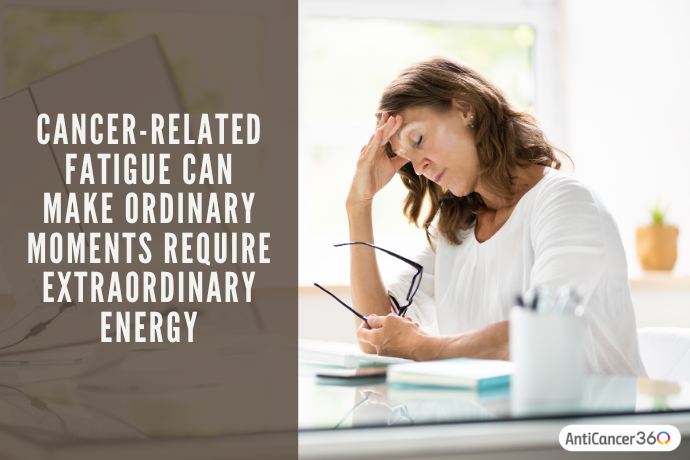
A shower can feel like a project.
Preparing a meal, climbing stairs, grocery shopping, concentrating during a conversation, or answering emails can suddenly consume a surprising amount of energy.
Cancer-related fatigue is recognized as a persistent sense of physical, emotional, or cognitive exhaustion related to cancer or cancer treatment that can be disproportionate to recent activity and interfere with daily functioning. Clinical cancer-fatigue guidelines recommend that fatigue be assessed throughout treatment and survivorship rather than dismissed as an unavoidable inconvenience [1].
That last part matters: this is not simply being sleepy.
Some people experience fatigue throughout the day. Others have periods of relatively normal energy followed by sudden crashes. You may feel physically exhausted but unable to sleep, or sleep for hours and still wake feeling depleted.
Cancer-related fatigue is not a failure to rest enough or try hard enough.
Your Body May Be Doing More Work Than You Can See
One reason cancer fatigue can be so frustrating is that much of what contributes to it is happening beneath the surface.
Even while you are resting, your body may be responding to cancer or recovering from treatment. Cells may be repairing tissue damage. Immune activity may be changing. Hormonal and inflammatory signals may be shifting. Eating enough may be harder. Sleep may be disrupted.
From the outside, you may simply look like you are sitting quietly on the couch.
Internally, your body may be managing multiple demands at once.
This can make fatigue particularly difficult for other people to understand. Someone may look completely fine while simultaneously feeling profoundly exhausted. Well-meaning family members may say, “Maybe you need more sleep,” or encourage you to push through it.
But cancer fatigue is rarely that simple.
Sometimes the exhaustion you can feel is the visible part of a tremendous amount of invisible work.
Inflammation May Be One Part of the Fatigue Puzzle
Researchers have spent years investigating the biological mechanisms behind cancer-related fatigue, and changes in inflammatory signaling appear to be one possible contributor.
Inflammation itself is not inherently harmful. It is a normal part of the body’s immune response and plays an important role in responding to injury and coordinating repair.
During cancer and some cancer treatments, however, inflammatory signaling can change. The immune system releases signaling molecules called cytokines, which allow cells to communicate and help coordinate immune activity.
Research examining the mechanisms of cancer-related fatigue has linked inflammatory pathways with fatigue symptoms, but inflammation does not fully explain why one person becomes profoundly fatigued while another does not. Cancer-related fatigue appears to involve multiple interacting biological, psychological, and behavioral factors.
One way to picture this is to think about how you feel when you have the flu.
Your body may become tired and achy. Motivation drops. You want to lie down and withdraw from normal activity. These kinds of responses are sometimes described as “sickness behavior” and reflect, in part, communication between the immune system and brain.
Cancer-related fatigue is much more complex than having the flu, but similar biological communication may be one piece of that feeling that your entire system is asking you to slow down.
Inflammation is therefore one possible contributor—not a single explanation for cancer fatigue.
Cancer Treatment Creates Its Own Energy Demands
Cancer treatment asks a great deal of the body.
Chemotherapy, radiation therapy, surgery, immunotherapy, targeted therapies, hormonal therapies, and other medications can contribute to fatigue through different mechanisms.
Treatment can affect healthy tissue alongside cancer cells. Surgery requires healing. Some therapies alter immune activity. Others affect hormones, appetite, sleep, blood counts, or neurological function.
The experience also varies tremendously.
One person may notice fatigue that peaks several days after chemotherapy and gradually improves before the next cycle. Another may experience fatigue that accumulates over several weeks of radiation. Someone else may continue experiencing fatigue months after treatment has ended.
There is no single “normal” timeline.
What is important is recognizing that your body is not simply going through ordinary life while treatment happens in the background.
It is adapting, repairing, and responding at the same time.
Anemia and Other Treatable Problems Can Make Fatigue Worse
Cancer-related fatigue is common, but that does not mean every episode of exhaustion should automatically be blamed on cancer.
Sometimes another contributor needs attention.
Anemia is one example. Red blood cells and the hemoglobin they contain help transport oxygen throughout your body. Cancer itself and certain treatments can reduce red blood cells or hemoglobin, contributing to weakness and fatigue.
Other medical and treatment-related factors may contribute as well, including pain, infection, medication effects, dehydration, nutritional problems, endocrine changes, depression, anxiety, and sleep disorders. Cancer-fatigue guidelines therefore recommend evaluating potentially reversible contributors rather than simply assuming fatigue must be endured.

This is why significant or worsening fatigue deserves a conversation with your oncology team.
You do not have to accept every episode of exhaustion as something you are simply expected to live with.
Identifying what is contributing to your fatigue can sometimes reveal something that can be treated, modified, or better supported.
Fatigue and Loss of Strength Can Reinforce Each Other
When you are exhausted, moving less makes complete sense.
But over time, fatigue and physical deconditioning can begin reinforcing one another.
Less activity can contribute to loss of muscle strength and cardiovascular fitness. As strength and conditioning decrease, ordinary tasks require a greater percentage of your available capacity.
Suddenly, climbing the stairs takes more effort. Standing long enough to cook dinner feels harder. Carrying groceries requires more energy.
That can lead to even less movement.
And the cycle continues.
Muscle also does considerably more than help you move. Skeletal muscle contributes to physical function, metabolism, glucose regulation, and communication with other body systems.
Preserving as much strength and function as safely possible can therefore be an important part of supporting your body during and after treatment.
And this leads to one of the more counterintuitive findings in cancer-fatigue research.
Rest Feels Logical, but Movement Has Some of the Strongest Evidence
When you are exhausted, being told to exercise can sound almost absurd.
But exercise is one of the best-supported interventions we currently have for cancer-related fatigue.
The 2024 American Society of Clinical Oncology and Society for Integrative Oncology guideline recommends exercise for reducing cancer-related fatigue both during cancer treatment and after treatment. Those recommendations were developed from randomized clinical trial evidence, not simply observational studies [2].
Exercise-oncology research suggests that moderate-intensity aerobic exercise around three times per week, particularly when continued over approximately 12 weeks, can reduce cancer-related fatigue. Combined aerobic and resistance programs performed two to three times per week have also shown benefit.
That does not mean you need to jump immediately into long or exhausting workouts.
The broader exercise goal commonly used for cancer survivors is to gradually work toward approximately 150 minutes of moderate-intensity activity each week, along with strength training around twice weekly. But where you begin depends on your treatment, current fitness, symptoms, blood counts, balance, bone health, surgery, cardiovascular health, and other individual considerations.
A Simple Movement Starting Point
If your healthcare team has cleared you for exercise, a beginner day might look something like this:
5 minutes: Start slowly with an easy walk or gentle mobility.
15–20 minutes: Walk at a moderate pace—an effort where you feel like you are exercising but can still speak in sentences.
5 minutes: Slow the pace and cool down.
That gives you roughly 25–30 minutes of intentional movement.
If 30 minutes feels completely unrealistic right now, start with five or ten.
A ten-minute walk is still movement.
You can also split activity across the day: ten minutes in the morning, ten minutes after lunch, and ten minutes later in the afternoon.
On two days each week, adding a few simple resistance exercises—such as standing from a chair, wall push-ups, resistance-band rows, or light weights—may help support strength. Exercise-oncology consensus recommendations support both aerobic and resistance training, with the specific prescription adjusted for the individual.
The goal is not to prove how much you can tolerate.
It is to give your body an appropriate dose of movement that preserves function without ignoring what it is telling you.
Sleep Matters, but More Sleep Does Not Always Solve Fatigue
Fatigue and sleepiness are related, but they are not the same experience.
Sleepiness usually creates a drive to sleep. Cancer-related fatigue can persist even when you have spent plenty of time in bed.
Cancer and treatment can also make restorative sleep harder to achieve. Pain, medications, anxiety, hormonal changes, hot flashes, treatment schedules, hospital interruptions, stress, and changes in routine can all interfere with sleep.
That can create the frustrating experience of saying:
“I slept all night and still feel exhausted.”
If poor sleep is contributing to fatigue, addressing the sleep problem may help. But simply spending more and more hours in bed does not necessarily address all of the biological, psychological, and physical factors involved in cancer-related fatigue.
Rest still matters.
It just may not be the whole prescription.
Stress Can Drain Energy Even When You Are Sitting Still
Cancer brings more than physical demands.
There are appointments. Scans. Waiting for results. Financial concerns. Changes in family roles. Treatment decisions. Uncertainty about what comes next.
Your nervous system responds to those experiences too.
Stress activates biological systems designed to help you respond to threat and uncertainty. In the short term, that response can be useful. But prolonged worry, vigilance, disrupted sleep, and emotional strain can become exhausting themselves.
You may even feel tired and wired at the same time: physically depleted but unable to fully settle.
Importantly, this does not mean fatigue is “all in your head.”
Physical symptoms, thoughts, emotions, behaviors, sleep, and stress physiology continually influence one another.
This is one reason current cancer-fatigue guidelines include psychological and mindfulness-based interventions alongside physical activity.
Three Evidence-Based Ways to Begin Supporting Cancer Fatigue
There is no single treatment for cancer-related fatigue because there is no single cause.
But three approaches have particularly strong guideline support: exercise, cognitive behavioral therapy, and mindfulness-based interventions. ASCO and the Society for Integrative Oncology recommend these approaches during and/or after cancer treatment based on randomized clinical trial evidence, although the strength and certainty of evidence vary among interventions and populations [3].
You do not need to master any of them today.
Here is what a first step might look like.
1. Use Movement as Medicine—Without Pushing Through Your Body
Start with the amount of movement your body can reasonably tolerate today.
If that is 20–30 minutes of walking, wonderful.
If that is five minutes around the block, start there.
Try choosing a repeatable amount rather than doing so much on a good day that you spend the following day recovering.
For example:
Monday: 20-minute walk
Tuesday: 10-minute walk + a few gentle strength exercises
Wednesday: Rest or gentle stretching
Thursday: 20-minute walk
Friday: 10-minute walk + gentle strength exercises
Weekend: One comfortable walk or enjoyable form of movement
That is not a prescription or a magic formula. It is an example of how you might begin building consistency while eventually working toward the amount of activity recommended in cancer-exercise guidelines.
Your starting point may be much smaller.
That is okay.
Consistency matters more than winning the workout.
2. Try a Five-Minute Mindfulness Practice
Mindfulness-based programs are recommended in current cancer-fatigue guidelines, with randomized trials supporting their use for fatigue during and after treatment. These studies typically evaluate structured programs rather than a single five-minute meditation, so the exercise below should be viewed as an introduction to the skill rather than the equivalent of a full mindfulness intervention.

Set a timer for five minutes.
Sit or lie somewhere reasonably comfortable.
Notice where your body is supported by the chair, bed, or floor.
Bring your attention to your breathing without trying to change it.
Notice one inhale.
Then one exhale.
Your mind will wander. That is not failure—it is part of the practice.
When you notice yourself thinking about your next appointment, tomorrow’s scan, something you need to do, or how tired you feel, gently recognize:
“Thinking.”
Then bring your attention back to the physical sensation of one breath.
You can also choose another anchor: the feeling of your feet on the floor, sounds in the room, or the sensation of your hands resting in your lap.
Repeat this process for five minutes.
The purpose is not to empty your mind.
It is to practice noticing what your mind and body are doing without having to follow every thought somewhere else.
3. Borrow a Simple Tool From CBT
Cognitive behavioral therapy, or CBT, is based on the idea that thoughts, emotions, and behaviors continually influence one another.
Structured CBT has randomized-trial evidence for cancer-related fatigue and is recommended by ASCO during and after cancer treatment. A trained therapist can individualize CBT to the patterns contributing to your fatigue, so a self-guided exercise should be considered an introduction rather than a substitute for therapy [4].
One simple place to begin is noticing the automatic thoughts that appear around fatigue.
Imagine you planned to walk for 20 minutes but became exhausted after ten.
An automatic thought might be:
“I should be able to do more than this.”
That thought may lead to frustration, guilt, sadness, or the urge to give up altogether.
Instead, try a brief thought record:
What happened?
I became tired after walking for ten minutes.
What was my automatic thought?
“I’m failing. I should be able to do more.”
What am I feeling?
Frustrated, discouraged, embarrassed.
What evidence supports that thought?
I used to be able to walk much farther.
What evidence does not support it?
I am undergoing or recovering from cancer treatment. My energy is different right now. I still walked for ten minutes.
What would be a more balanced thought?
“Ten minutes is what my body had available today. That still counts, and I can adjust based on how I feel tomorrow.”
The goal is not positive thinking.
It is more accurate thinking.
You can use the same process when you notice catastrophizing—“I am never going to feel like myself again”—all-or-nothing thoughts—“If I can’t exercise normally, there is no point doing anything”—or “should” statements—“I should be handling this better.”
Another CBT principle is behavioral activation: when fatigue and low mood cause life to become smaller, schedule one manageable activity that gives you a sense of pleasure, connection, or accomplishment.
Maybe it is sitting outside with your coffee.
Calling a friend.
Walking for five minutes.
Listening to music while you shower.
The activity does not have to be impressive.
It needs to be doable.
Fatigue Can Change How You See Yourself
There is another part of cancer-related fatigue that rarely shows up on a laboratory result.
It can affect identity.
Maybe you have always been the active one.
The caregiver.
The person who gets everything done.
And suddenly you need help carrying groceries.

You have to cancel plans because your energy disappeared. You need to sit down halfway through something that once felt effortless. You may find yourself measuring your days according to how much energy you have available.
There can be grief in that.
There can also be frustration, guilt, and the quiet question:
“Why can’t I do what I used to do?”
Cancer fatigue is not laziness.
It is not weakness.
It is not a lack of effort.
Your capacity may genuinely be different right now.
Sometimes understanding what is happening physiologically does something important beyond explaining a symptom: it creates a little room for compassion toward a body that may already be working incredibly hard.
Frequently Asked Questions About Cancer-Related Fatigue
How long does cancer fatigue last?
There is no single timeline. Fatigue may occur during treatment, fluctuate between treatment cycles, gradually improve after treatment, or continue into survivorship. Persistent, severe, or worsening fatigue should be discussed with your healthcare team so potentially treatable contributors can be evaluated.
Why am I still tired after sleeping all night?
Cancer-related fatigue is not the same as ordinary sleepiness. Poor sleep may contribute, but treatment effects, anemia, pain, medications, emotional distress, nutrition, physical deconditioning, and other medical factors can also play a role. That is why getting more sleep alone may not completely relieve cancer-related fatigue.
Should I exercise if cancer treatment makes me exhausted?
For many people, appropriately tailored exercise can help. Randomized clinical trials support exercise for reducing cancer-related fatigue, and ASCO recommends exercise during and after treatment. The appropriate amount depends on your condition, treatment, blood counts, bone health, surgery, symptoms, and current fitness, so ask your healthcare team about necessary modifications [5].
Can anemia cause cancer fatigue?
Yes. Cancer and some treatments can lower red blood cells or hemoglobin, reducing the blood’s ability to carry oxygen efficiently. Anemia can contribute to fatigue and weakness and is one of several potentially treatable factors your healthcare team may evaluate when fatigue becomes significant.
Is cancer-related fatigue a sign that my cancer is getting worse?
Not necessarily. Fatigue is common during cancer and cancer treatment and has many possible causes. New, severe, or worsening fatigue should still be discussed with your healthcare team so they can evaluate what may be contributing rather than assuming it is simply an expected part of cancer.
What actually helps cancer-related fatigue?
Exercise, cognitive behavioral therapy, and mindfulness-based interventions have some of the strongest current guideline support. ASCO and the Society for Integrative Oncology recommend these approaches during and/or after cancer treatment based on randomized clinical trial evidence. Treating contributing medical, sleep, nutritional, or psychological issues may also be important [6].
One next step: If fatigue is interfering with your daily life, tell your oncology team specifically how it is affecting you and ask two questions: Could something treatable be contributing to this, and what level of movement is safe for me right now?
Which describes you best?
Please select one of the options below, and you'll be guided to the online training that best fits your situation.

I'm fighting an advanced (or late stage) cancer and I'm determined to "beat the odds."

I'm fighting an earlier staged cancer, and want to maximize the outcome & minimize the side effects.

Samantha is a registered nurse, and Integrative Health Coach with Anticancer360. She holds a Bachelor of Science in Nursing from the University of Tulsa, and brings a unique blend of clinical expertise and whole-person care to support our clients along their healing journeys. She has spent the past 15 years as a registered nurse and clinical case manager at UCLA, where her work has been deeply rooted in oncology care.