
Muscle loss during cancer treatment can happen quietly, even when the number on the scale barely changes.
You may notice stairs feel harder, getting out of a chair takes more effort, or groceries suddenly feel heavier—even if the number on the scale has barely changed. That is because body weight does not always reflect what is happening to muscle underneath.
Preserving muscle during treatment is not about appearance or fitness goals. It is about helping maintain strength, physical function, independence, and the reserve your body may need during a demanding period.
Key Takeaways
- Stable weight does not necessarily mean stable muscle. Muscle can decrease even when body weight changes very little.
- Resistance exercise matters because muscle needs a reason to stay. Walking is valuable, but it does not provide the same stimulus as strength-based movement.
- Protein supports muscle maintenance, but more is not automatically better. Needs vary based on age, body composition, activity, treatment, recovery needs, and the dietary strategy you are following.
- Changes in function can matter as much as changes on the scale. Difficulty standing from a chair, climbing stairs, walking, or carrying everyday objects may be worth mentioning to your care team.
- Rapid or ongoing muscle loss is not something to simply push through. Cancer cachexia is a complex metabolic condition that cannot be corrected with food or exercise alone.
As an oncology RN and integrative health coach, I have seen how easily conversations about weight can overshadow a more meaningful question: How well is your body functioning? During cancer treatment, maintaining strength may sometimes tell us more about what the body needs than the scale ever could.
The Scale Can Miss Muscle Loss
When most people think about losing muscle, they imagine obvious weight loss. But muscle loss is not always that visible.
Changes in body composition can occur even when total body weight stays relatively stable. Someone may lose muscle while maintaining fat mass or retaining fluid, meaning the scale changes very little even though strength and physical function are declining.

That is one reason cancer nutrition guidelines recommend paying attention not only to weight, but also to changes in muscle mass, nutritional intake, and physical function. ESPEN, the European Society for Clinical Nutrition and Metabolism, specifically recommends monitoring body weight, food intake, and physical performance throughout cancer care rather than relying on a single measurement alone.
You do not need a body-composition scan to notice meaningful changes.
Pay attention to everyday function. Are you using your arms to push yourself out of a chair when you did not before? Do stairs leave your legs unusually tired? Has your usual resistance exercise become significantly harder? Are you walking more slowly or avoiding activities because they suddenly require much more effort?
These changes do not automatically mean you are losing significant muscle, but they can be useful signals to bring to your care team.
Cancer Treatment Can Create the Conditions for Muscle Loss
Muscle is constantly being broken down and rebuilt. Under ordinary circumstances, nutrition and physical activity help keep those processes in balance.
Cancer and its treatment can disrupt that balance from several directions at once. Reduced appetite, nausea, taste changes, mouth sores, digestive symptoms, fatigue, hospitalization, surgery, and decreased activity can all reduce the nutrition or physical stimulus needed to maintain muscle. At the same time, illness and inflammation can increase muscle breakdown in some people.
The result can be a difficult cycle.
As strength declines, movement becomes harder. When movement becomes harder, activity may decrease further. Eating enough can also become more difficult, especially when treatment symptoms are affecting appetite or digestion.
The goal is not to prevent every change in your body during treatment. That may not be realistic.
The goal is to identify the factors you can influence and support muscle where possible without turning treatment into another fitness program you are expected to perform perfectly.
Resistance Exercise Gives Muscle a Reason to Stay
Walking is excellent movement. It supports cardiovascular fitness, circulation, mobility, mood, and many other aspects of health.
But walking and resistance exercise do not do exactly the same job.

Resistance exercise places muscles under load. That load sends the body a signal that the muscle is still needed. This can come from weights, resistance bands, body weight, exercise machines, or even modified everyday movements such as repeatedly standing up from a chair.
That distinction matters during cancer treatment.
The American Society of Clinical Oncology recommends both aerobic and resistance exercise during active cancer treatment when appropriate. Clinical trials reviewed by ASCO found that exercise during treatment can help preserve physical function and strength while also improving several other treatment-related outcomes. Importantly, the evidence does not establish that exercise prevents recurrence or improves survival, so the reason to exercise here is supportive care—not treating the cancer itself.
How much resistance exercise is right for you depends on your treatment, baseline fitness, symptoms, and medical situation. ASCO specifically notes that evidence during active treatment is not precise enough to prescribe one universal frequency, duration, or intensity for every patient. Some people can exercise independently, while others may benefit from oncology rehabilitation or a supervised program.
For someone who is medically cleared and new to resistance work, a starting session might be very simple:
- Sit down and stand from a sturdy chair several times.
- Perform a gentle row using a resistance band.
- Press light weights or household objects overhead if shoulder mobility allows.
- Practice supported squats or heel raises while holding a counter.
You do not need to train to exhaustion for the movement to count. The goal is to provide enough resistance that the muscles are being asked to work while still respecting your current energy, balance, pain, blood counts, bone health, and treatment-related limitations.
Supporting Muscle Requires Enough Protein—Not Necessarily More Protein
Exercise provides the stimulus. Nutrition provides the materials.
Protein supplies amino acids the body uses to repair and maintain tissues, including skeletal muscle. When someone is eating less because of treatment or recovering from surgery, simply meeting protein needs can become more difficult.
But this is where the message needs some nuance.
More protein is not automatically better.
Current ESPEN cancer nutrition guidance recommends protein intake above 1 gram per kilogram of body weight per day and, when possible, up to about 1.5 grams per kilogram per day. This is a general clinical range rather than a prescription for every person with cancer.
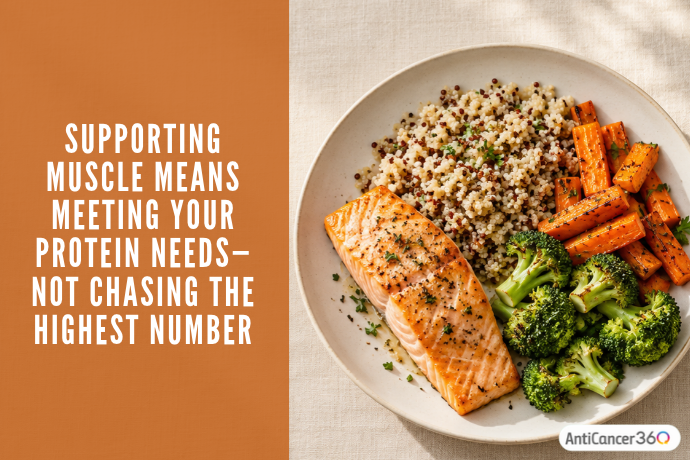
AntiCancer360 also individualizes protein rather than applying one number universally. Dr. Gene’s framework includes different targets based on whether someone is following a standard cancer-support diet, a ketogenic approach, exercising regularly, undergoing treatment or surgery, or is an older adult. His general cancer-support range is likewise 0.8–1.5 grams per kilogram of total body weight, while noting that individual circumstances may raise or lower the appropriate target.
This means preserving muscle is not about chasing the highest possible protein number.
It is about getting enough for your situation.
For one person, that may mean intentionally adding more protein because treatment has dramatically reduced intake. For another, it may mean staying within a moderate target because of their overall nutritional strategy, kidney function, metabolic considerations, or other medical factors.
Dr. Gene’s framework also recommends distributing daily protein across meals rather than consuming the entire amount at once.
If you are unsure what your protein target should be, especially if you are losing weight or strength, that is a useful question for your oncology dietitian or AntiCancer360 care team.
When Eating Is Difficult, Focus on What the Protein Is Accomplishing
Treatment can make even a reasonable protein goal feel surprisingly difficult.
A full plate of chicken, fish, eggs, beans, or another protein-rich food may sound manageable on paper. It can feel very different when you are nauseated, full after several bites, struggling with mouth sores, or suddenly finding foods you normally enjoy unappealing.
This is where perfection becomes less useful than strategy.
Rather than trying to eat a large protein-heavy meal, it may be easier to distribute smaller amounts throughout the day. Depending on your nutritional plan and treatment tolerance, that might mean adding a protein source to breakfast, choosing a protein-containing snack, using a shake when chewing feels difficult, or making a smaller meal more nutrient-dense.
The exact food matters less than whether it fits the rest of your treatment and nutrition plan.
And if eating itself has become consistently difficult, do not wait until significant weight loss has occurred to bring it up. Nausea, early fullness, swallowing difficulty, diarrhea, mouth sores, taste changes, pain, and other treatment effects can all interfere with adequate intake and may be treatable. NCI recommends involving an oncology dietitian early when appetite or weight begins to decline.
That is different from simply being told to “eat more protein.”
Sometimes the most important muscle-preserving intervention is addressing why eating has become difficult in the first place.
Muscle Loss Is Not Always Something You Can Fix With Food and Exercise
There is another reason we need to be careful about placing responsibility on the patient.
Some people with cancer develop cancer cachexia, a complex wasting syndrome involving loss of skeletal muscle and often body weight and fat. Cachexia is different from simply eating too little.
Inflammation and changes in metabolism can alter the way the body uses nutrients and muscle tissue. Because of that, cancer cachexia cannot be reversed with nutrition alone. NCI describes it as a condition requiring multidisciplinary medical care and emphasizes that treatment is more likely to help when problems are recognized earlier.
This distinction matters emotionally as much as medically.
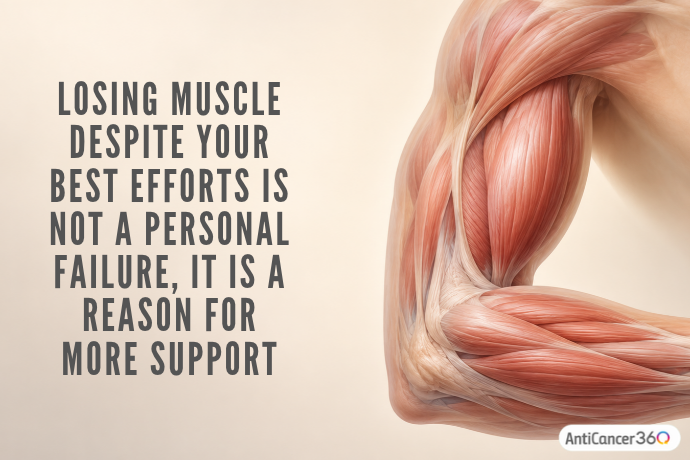
If someone continues losing muscle despite trying to eat, move, and follow every recommendation they have been given, that does not mean they have failed to nourish or strengthen themselves correctly.
ASCO’s cachexia guideline similarly notes that dietary counseling and nutritional supplements may help some people maintain or gain weight, but the evidence remains limited, and cachexia often requires broader clinical management.
Tell your oncology team if you notice ongoing involuntary weight loss, a major decline in appetite, progressive weakness, or a meaningful change in your ability to complete everyday activities.
Those are not symptoms you need to solve by simply trying harder at the gym or adding another protein shake.
Preserving Function May Be a Better Goal Than Preserving a Number
There is something freeing about changing the question.
Instead of asking:
“Am I maintaining my weight?”
You might also ask:
“Am I maintaining the strength I need to live my life?”
Can you still rise from a chair comfortably? Walk through the grocery store? Carry laundry? Climb the stairs in your home? Continue an exercise you normally enjoy?
These are ordinary tasks, but during treatment they become meaningful measures of physical reserve.
Preserving muscle is not necessarily about building a stronger-looking body. Sometimes it is about keeping enough strength to move through your day with a little more independence and a little less effort.
The body is already being asked to do something extraordinary.
Supporting muscle is one way of helping preserve the physical capacity that carries you through it.
Frequently Asked Questions
Can I lose muscle without losing weight?
Yes. Changes in body composition can occur even when total body weight remains relatively stable. Muscle may decrease while fat mass or fluid stays the same or increases. That is why changes in strength, mobility, appetite, and physical function can provide useful information alongside the number on the scale.
Is walking enough to prevent muscle loss during cancer treatment?
Walking is valuable for cardiovascular fitness, mobility, and overall activity, but it does not provide the same muscular stimulus as resistance exercise. When medically appropriate, oncology guidelines recommend including both aerobic and resistance exercise during active cancer treatment.
How much protein should someone with cancer eat?
Needs vary, but ESPEN recommends more than 1 gram of protein per kilogram of body weight per day and, when possible, up to about 1.5 grams per kilogram. Age, treatment, activity, nutritional status, kidney function, and the dietary approach being followed can all change what is appropriate.
Should I exercise if I feel weak during treatment?
Possibly, but weakness deserves context. Some people can safely continue or modify exercise, while others may need evaluation or supervised rehabilitation because of anemia, neuropathy, bone metastases, infection risk, cardiovascular issues, or other treatment effects. Discuss new or worsening weakness with your oncology team before simply pushing through it.
Is cancer cachexia the same thing as losing weight because I am eating less?
No. Cancer cachexia is a complex metabolic syndrome involving involuntary muscle loss and sometimes fat loss. Reduced food intake can contribute, but cachexia involves metabolic and inflammatory changes and cannot be reversed with nutrition support alone.
When should I ask for an oncology dietitian or physical therapist?
Earlier is usually better if you are experiencing involuntary weight loss, decreased appetite, progressive weakness, difficulty meeting nutrition needs, or a noticeable decline in everyday physical function. Oncology dietitians and rehabilitation specialists can help identify barriers and individualize nutrition and activity around treatment.
One Place to Start
Choose one ordinary movement that reflects your current strength—such as standing from a chair, climbing your usual stairs, or carrying a familiar grocery bag—and simply pay attention to how it feels this week.
If that task has become noticeably harder, mention the change to your oncology team. It may be a small observation, but it can open a useful conversation about nutrition, activity, rehabilitation, and preserving muscle before a larger decline occurs.
This article is for educational purposes and is not a substitute for individualized medical, nutrition, or exercise advice. Cancer type, treatment, blood counts, bone health, surgery, cardiovascular conditions, kidney function, neuropathy, and other factors can change what exercise and protein intake are appropriate for you. Discuss significant changes in nutrition or physical activity with your healthcare team.
Which describes you best?
Please select one of the options below, and you'll be guided to the online training that best fits your situation.

I'm fighting an advanced (or late stage) cancer and I'm determined to "beat the odds."

I'm fighting an earlier staged cancer, and want to maximize the outcome & minimize the side effects.

Samantha is a registered nurse, and Integrative Health Coach with Anticancer360. She holds a Bachelor of Science in Nursing from the University of Tulsa, and brings a unique blend of clinical expertise and whole-person care to support our clients along their healing journeys. She has spent the past 15 years as a registered nurse and clinical case manager at UCLA, where her work has been deeply rooted in oncology care.